


Drug Formulation and Development: Key Stages
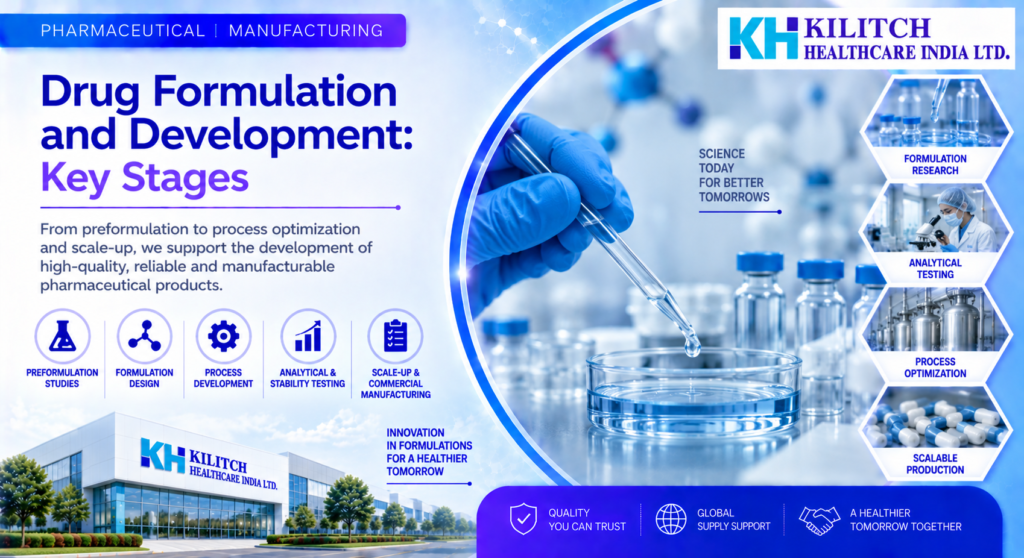
Introduction: Why Formulation and Development Matter A medicine does not move directly from an idea to production. Before a product can be manufactured consistently, its formulation, manufacturing process, quality attributes and stability need to be understood and controlled. Drug formulation and development brings together scientific and technical disciplines to transform an active ingredient and supporting materials into a dosage form that can be produced reliably. The work can include preformulation, formulation optimization, process development, analytical testing, stability evaluation and scale-up. It also considers how the formulation behaves during manufacturing and storage. Companies evaluating a partner for drug formulation and development can look for capabilities that connect development work with practical commercial manufacturing. What Is Drug Formulation and Development? Drug formulation is the process of designing a medicine in a suitable dosage form by combining an active pharmaceutical ingredient with appropriate excipients and processing methods. The formulation needs to achieve the intended characteristics for its route of administration, stability, performance and patient use. Development takes that formulation further by establishing the processes and controls needed to produce it consistently. Development teams investigate variables such as ingredient compatibility, concentration, mixing, filling, sterilization, container systems and storage conditions, depending on the product. The objective is not simply to create a formulation, but to establish a scientifically supported and manufacturable product. Key Stages of Drug Formulation and Development 1. Preformulation Studies Preformulation provides information about the active ingredient and its physical properties. Solubility, stability, compatibility, particle characteristics and other attributes can influence formulation choices. Understanding these properties early can help guide the selection of excipients, dosage forms and processing approaches. 2. Formulation Design Once key material properties are understood, development teams can begin designing the formulation. The choice of ingredients and their proportions depends on the desired product characteristics. Different dosage forms may require very different formulation strategies, and the intended route of administration can influence both formulation and manufacturing decisions. 3. Process Development A formulation must be supported by a repeatable manufacturing process. Process development examines how materials are handled and converted into the finished dosage form. Parameters such as mixing, filling, temperature, time and other process conditions may need to be established and controlled according to the product. 4. Analytical and Stability Evaluation Analytical testing helps establish whether the formulation meets defined quality requirements. Stability studies show how the product behaves over time under specified storage conditions. Together, these activities help teams understand product quality and establish specifications. From Development to Commercial Manufacturing Scale-Up Considerations Moving a formulation from development scale to commercial production can introduce new variables. Commercial equipment may have different operating characteristics, batch sizes may be larger and material behavior can change with scale. Scale-up therefore requires careful assessment of process parameters and equipment suitability. A successful scale-up aims to maintain the established quality attributes of the formulation while creating a process that is practical for routine production. Clear documentation and process understanding support this transition. Technology Transfer Technology transfer connects development knowledge with the manufacturing site or commercial production team. Information about the formulation, process parameters, analytical methods, specifications, equipment and critical controls needs to be transferred accurately. For businesses researching Kilitch Drugs, understanding this transfer process can help clarify how an established formulation moves into controlled commercial production. For businesses researching Kilitch Drugs and related product-development requirements, technology transfer is one area worth examining because it can influence how efficiently an established formulation moves into controlled commercial production. Specialized Formulation Development Not all medicines have the same formulation challenges. Sterile injectables, ophthalmic products, nasal formulations and prefilled delivery systems can require specialized development approaches and manufacturing controls. The route of administration, sterility requirements, viscosity, container system and product stability can all influence development decisions. Kilitch Healthcare works across several specialized healthcare categories, including sterile injectables, ophthalmic formulations, nasal formulations and prefilled syringes. Businesses researching Kilitch Drugs can consider how dosage-form expertise and production environments support their intended product. Specialized technology can also support formulation goals. For example, preservative-free delivery systems or gel-based formulations may require specific approaches to formulation, filling and packaging. Businesses evaluating these technologies can consider how formulation and manufacturing teams work together to translate them into commercial production. The Role of Quality in Formulation Development Defining Critical Quality Attributes Development teams identify the characteristics that are important to product quality and performance. Depending on the dosage form, these may include assay, purity, uniformity, sterility, viscosity, particle characteristics, dissolution or other product-specific attributes. Understanding these characteristics helps guide formulation and process decisions. Building a Robust Process A robust development process considers how normal variation in materials and manufacturing conditions could affect the finished product. Developers may study process parameters and material attributes to understand which variables are most important. This knowledge can inform manufacturing controls and specifications. Documentation and Traceability Development decisions should be supported by clear documentation. Formulation records, test results, development reports and process information provide a foundation for technology transfer and regulatory activities. Why Integrated Development and Manufacturing Matters Development and manufacturing should not operate as completely separate activities. A formulation that performs well in development still needs to be practical, scalable and controllable in production. Early collaboration between formulation scientists, process teams, quality specialists and manufacturing personnel can help identify production challenges before commercial scale-up. An integrated approach can also support faster decision-making when formulation or process adjustments are required. A manufacturer with development and production capabilities can evaluate changes with a clearer understanding of how they may affect equipment, quality controls and commercial supply. This continuity can be particularly valuable for products moving from development into long-term manufacturing. How to Evaluate a Drug Development Partner Look at Scientific and Technical Expertise Review the partner’s formulation capabilities, dosage-form experience, development infrastructure and ability to support process optimization. The relevant expertise should match the product’s scientific and manufacturing requirements. Assess Analytical and Quality Capabilities Analytical testing and quality systems should be considered alongside formulation expertise. Development decisions depend on reliable data, while commercial manufacturing depends on controlled specifications, validation and documented
Understanding Modern Pharmaceutical Manufacturing
Introduction: The Role of Drug Manufacturing Today The healthcare industry depends on a manufacturing ecosystem that can turn scientific formulations into consistent, safe and commercially viable products. A drug manufacturing company is central to this journey, combining formulation expertise, production systems, quality controls and regulatory practices to deliver medicines and healthcare products at scale. As patient needs become more specialized, manufacturers also need capabilities that support different dosage forms, sterile environments, advanced delivery systems and evolving market requirements. Modern manufacturing is no longer limited to producing a finished medicine. It can involve research and development, process optimization, technology transfer, scale-up, quality assurance, packaging and commercialization. Companies seeking a manufacturing partner therefore evaluate much more than production capacity. They look for technical knowledge, reliable systems, innovation and the ability to maintain consistent quality from one batch to the next. In this context, organizations researching Kilitch Drugs can also evaluate the range of specialized manufacturing capabilities available for sterile injectables, ophthalmic formulations, nasal formulations, prefilled syringes and swab-sticks. Understanding the Drug Manufacturing Process From Formulation to Scale-Up Drug manufacturing begins with a clearly defined formulation and manufacturing process. Development teams work to establish the right composition, dosage form, stability characteristics and production parameters. Once a formulation is ready for manufacturing, the process must be translated into a controlled, repeatable operation. Scale-up is particularly important because a process that works at development scale may require adjustment before commercial production. Controlled Production Production involves controlled handling of raw materials, equipment, environmental conditions and process parameters. Depending on the dosage form, manufacturers may use specialized facilities and procedures. Sterile products, for example, require stringent controls designed to minimize contamination risks. Consistency is essential because every commercial batch should meet predefined specifications and quality requirements. Packaging and Product Protection Packaging is another important part of manufacturing because it protects the product and supports correct use throughout its intended shelf life. The selected container or delivery system can be especially important for ophthalmic, injectable and other sensitive products. Manufacturing expertise therefore extends beyond filling a product into a pack; it includes selecting and validating processes that support product integrity. Why Quality Systems Matter in Drug Manufacturing Quality Assurance and GMP A strong quality system provides the framework for consistent manufacturing. Good Manufacturing Practices, commonly known as GMP, guide activities ranging from material handling and documentation to production controls, testing and release. A reliable drug manufacturing company integrates quality into the process rather than treating inspection as a final step. Testing and Batch Consistency Quality control activities help verify that materials, in-process samples and finished products meet defined specifications. Documentation and traceability allow manufacturers to understand what happened during production and support investigation when deviations occur. Consistent procedures also help reduce variability and provide confidence that approved processes are being followed across batches. Regulatory Readiness Manufacturers serving regulated markets must also understand applicable regulatory expectations. This can influence facility design, documentation, validation, testing, data integrity and change control. Building these disciplines into daily operations makes manufacturing more structured and supports the requirements associated with domestic and international markets. Technology, Innovation and Specialized Manufacturing Technology continues to reshape drug manufacturing by improving process control, product delivery and manufacturing efficiency. Advanced equipment, automation and validated technologies can support repeatability while specialized delivery formats can improve convenience and usability for patients and healthcare professionals. Technology continues to reshape drug manufacturing by improving process control, product delivery and manufacturing efficiency. Advanced equipment, automation and validated technologies can support repeatability while specialized delivery formats can improve convenience and usability for patients and healthcare professionals. For businesses researching Kilitch Drugs, these manufacturing technologies can be particularly relevant when evaluating specialized dosage forms and controlled production environments. Research and development also plays a central role in innovation. A manufacturer with technical R&D capabilities can evaluate formulations, optimize processes and work with partners during development and scale-up. This becomes valuable when a product needs to move from an initial concept to a reliable commercial process without losing its intended quality attributes. Choosing the Right Manufacturing Partner Evaluate Technical Capabilities The right partner should have capabilities that match the product being developed or commercialized. Companies should examine dosage forms, production lines, development expertise, analytical capabilities, packaging options and experience with the relevant product category. A mismatch between the product requirements and manufacturing infrastructure can create avoidable delays later in the project. Assess Quality and Compliance Quality systems deserve close attention during partner selection. Prospective clients can review manufacturing practices, documentation systems, quality control processes, validation capabilities and relevant certifications or regulatory experience. These factors provide a more meaningful picture of manufacturing readiness than production capacity alone. Consider Scalability and Collaboration A manufacturing relationship often extends beyond a single production run. Development, technology transfer, scale-up, supply planning and ongoing improvements may require continuous collaboration. A partner that can support multiple stages of the product lifecycle can simplify coordination as demand grows. The Growing Importance of Flexible Drug Manufacturing Healthcare markets continue to diversify, creating demand for different dosage forms, specialized therapies and delivery systems. Manufacturers must therefore balance standardized processes with the flexibility needed for specialized products. This includes adapting production systems, managing different packaging formats and maintaining rigorous quality controls across product categories. A manufacturing relationship often extends beyond a single production run. Development, technology transfer, scale-up, supply planning and ongoing improvements may require continuous collaboration. A partner that can support multiple stages of the product lifecycle can simplify coordination as demand grows. Kilitch Healthcare lists contract manufacturing, product development and commercialization, technology transfer for commercial supply and product licensing among its service areas, giving companies evaluating Kilitch Healthcare a broader view of the support that can sit around manufacturing itself. Conclusion: Building Reliable Healthcare Manufacturing Drug manufacturing is a multidisciplinary process that connects scientific development with controlled commercial production. From formulation and scale-up to quality assurance, specialized technologies, packaging and regulatory readiness, each stage contributes to the consistency and reliability of the finished product. Drug manufacturing is a multidisciplinary process that connects scientific development with
Healthcare Product Manufacturer: Key Capabilities
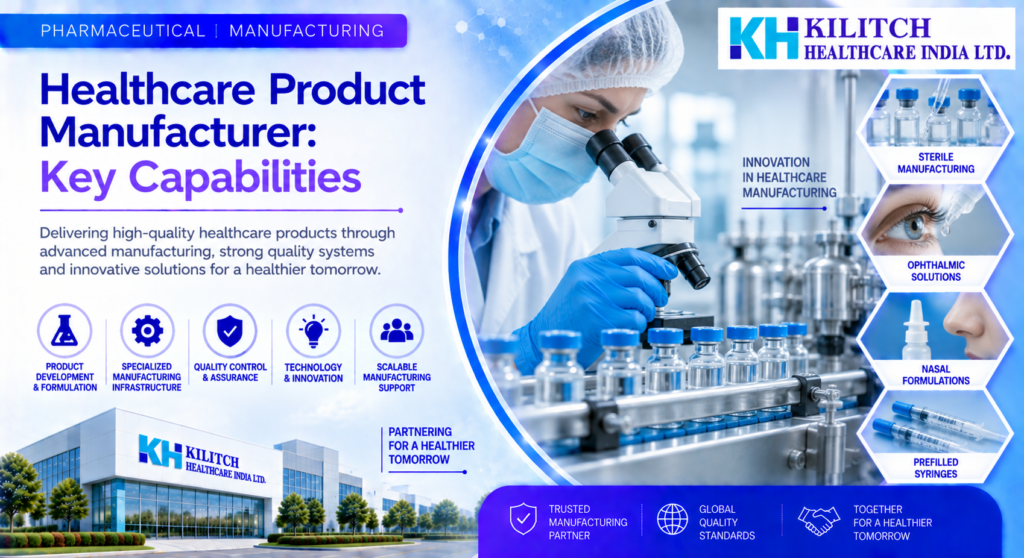
Introduction: The Growing Role of Healthcare Manufacturing Healthcare products support a wide range of medical and patient-care needs, from medicines and sterile products to specialized delivery formats and other healthcare applications. Behind these products is a manufacturing process that must balance technical precision, quality, regulatory requirements and dependable supply. A capable healthcare product manufacturer brings these disciplines together to turn validated formulations and product concepts into consistent finished products. The role of a manufacturer can extend well beyond production. Depending on the product and business model, services may include formulation development, process optimization, technology transfer, scale-up, quality testing, packaging and commercial manufacturing. A capable healthcare product manufacturer can support several stages of this journey, helping businesses coordinate development and production while maintaining defined quality requirements. Key Capabilities of a Healthcare Product Manufacturer Product Development and Formulation Product development is often the foundation of a successful manufacturing program. Manufacturers may work with formulations, dosage forms and delivery systems that require specific technical expertise. Development activities can include evaluating ingredients, optimizing processes, establishing manufacturing parameters and preparing a formulation for scale-up. A strong development approach also considers how a product will behave during commercial manufacturing. Parameters established during development need to be translated into repeatable processes that can be controlled at a larger scale. This connection between development and manufacturing can help reduce variability and support a smoother transition into routine production. Specialized Manufacturing Infrastructure Different healthcare products require different production environments and technologies. Sterile products, for example, demand stringent environmental and process controls. Ophthalmic products, nasal formulations, injectables and prefilled delivery systems can also require specialized equipment, controlled handling and carefully designed manufacturing procedures. Kilitch Healthcare works across specialized healthcare categories including sterile injectables, ophthalmic formulations, nasal formulations and prefilled syringes. Companies researching For businesses researching Kilitch Drugs, it is useful to consider the manufacturing infrastructure, technical capabilities and product categories available rather than focusing only on individual products. can therefore look beyond individual products and consider the manufacturing infrastructure, technical capabilities and product categories supported by the organization. Quality Control and Assurance Quality is fundamental to healthcare manufacturing because finished products must meet defined specifications consistently. Quality control can involve testing raw materials, monitoring processes, evaluating finished products and maintaining records that demonstrate compliance with established requirements. Quality assurance provides the wider system around these activities. It includes documented procedures, deviation management, change control, validation and other controls designed to keep manufacturing processes consistent. For companies selecting a partner, reviewing the manufacturer’s quality systems can be as important as reviewing its equipment and production capacity. Technology and Innovation in Healthcare Product Manufacturing Manufacturing technology continues to influence how healthcare products are developed, produced and delivered. Automation and modern equipment can improve process control, while specialized technologies can address particular product requirements. Innovation can also involve the interaction between formulation, container systems, filling processes and sterilization. For specialized products, these capabilities may become particularly important. Businesses exploring Kilitch Drugs can evaluate how specialized technologies, controlled environments and product-development expertise may support different healthcare requirements. Why Scalability Matters A healthcare product may begin with development quantities before moving into larger commercial batches. A manufacturing partner should therefore be able to support a controlled transition from development to scale-up without compromising established quality attributes. Equipment suitability, process validation, production planning and supply-chain coordination all become increasingly important as volumes grow. Scalability also matters when demand changes. Healthcare businesses may need to expand supply, introduce additional products or enter new markets. A manufacturer with flexible capabilities and established processes can help businesses manage these changes while maintaining consistency. This is particularly relevant for companies considering long-term contract manufacturing relationships rather than one-time production arrangements. Technology Transfer and Commercial Manufacturing Moving a Product into Production Technology transfer connects product development with routine manufacturing. During this stage, information about formulation, processes, equipment, testing and critical parameters must be transferred in a controlled manner. Clear documentation and communication help ensure that the commercial process reflects the intended product characteristics. Manufacturers supporting technology transfer can also help identify practical production considerations before commercial launch. This may include equipment compatibility, process controls, testing requirements and scale-up challenges. Early attention to these details can make the transition more structured and reduce avoidable manufacturing issues. Supporting Long-Term Product Supply Once a product reaches commercial production, consistent supply becomes an ongoing priority. Production scheduling, raw-material planning, quality release, packaging and logistics all contribute to supply reliability. A manufacturing partner should have processes that support repeatable production while allowing controlled changes when improvements or regulatory requirements arise. For companies evaluating a healthcare manufacturing relationship, it can therefore be useful to assess not only current production capabilities but also the manufacturer’s ability to support future requirements. Kilitch Healthcare describes services spanning contract manufacturing, product development and commercialization, technology transfer for commercial supply and product licensing, giving Kilitch Healthcare a broader role across the product lifecycle. How to Evaluate a Healthcare Product Manufacturer Match Capabilities to the Product Start with the product itself. Consider its dosage form, manufacturing environment, packaging requirements, testing needs and expected production volume. The ideal capability profile depends on these details, so a manufacturer should be evaluated against the actual technical requirements of the project. Review Quality and Compliance Quality systems should be assessed through documented processes, validation practices, testing capabilities and regulatory experience. Companies should also understand how the manufacturer manages deviations, changes, documentation and batch traceability. These elements help establish whether the manufacturing operation is structured for consistent healthcare production. Consider Communication and Collaboration Manufacturing projects involve multiple teams and stages, so communication can directly affect execution. Development, quality, production, regulatory and supply teams may all need to coordinate. A collaborative manufacturing partner can make information transfer and decision-making more organized throughout the project. Conclusion: Building Reliable Healthcare Products Healthcare manufacturing combines product knowledge, technical infrastructure, quality systems and operational discipline. A manufacturer capable of supporting development, specialized production, technology transfer and commercial supply can provide value across more than one stage of a product’s journey. For businesses
Key Factors to Consider When Choosing a Medicine Manufacturer
Introduction: Why the Choice of Manufacturer Matters A medicine manufacturer plays an important role in turning an approved formulation or healthcare product concept into a consistent finished product. Manufacturing involves much more than operating production equipment. It brings together technical expertise, quality systems, trained personnel, documentation, testing, packaging and supply planning. For businesses developing or commercializing medicines, the choice of manufacturing partner can therefore influence how efficiently a product moves from development into routine production. The right partner should be selected according to the product’s actual requirements. Dosage form, production environment, formulation complexity, expected volumes, packaging format and target markets can all affect the capabilities required. Businesses reviewing a potential medicine manufacturer can begin by comparing technical infrastructure and quality practices before moving into commercial discussions. Understanding Medicine Manufacturing Capabilities Formulation and Product Development Product development establishes the technical foundation for manufacturing. Depending on the project, a manufacturer may support formulation development, optimization, process development or scale-up. Development teams need to understand how ingredients, equipment and process parameters interact so that the resulting process can be translated into controlled commercial production. Strong development capabilities can also help identify manufacturing challenges early. A process may perform differently when moving from laboratory or pilot scale to larger batches, so scale-up planning is important. The goal is to create a repeatable process that maintains the intended quality attributes of the medicine. Specialized Dosage Forms Medicine manufacturing covers many dosage forms, and each can require different equipment and controls. Sterile injectables, ophthalmic products, nasal formulations and prefilled syringes, for example, may require specialized facilities, controlled environments and dedicated processes. Kilitch Healthcare works across several specialized healthcare categories. Businesses researching Kilitch Drugs can therefore consider not only the medicines themselves but also the manufacturing technologies, dosage-form expertise and production environments available to support them. Quality Systems and Manufacturing Standards Quality Assurance Quality assurance provides the framework for consistent manufacturing. It can include standard operating procedures, employee training, validation, change control, deviation management, corrective and preventive actions, documentation review and batch release. These controls help ensure that production activities remain aligned with approved procedures and specifications. For a company selecting a manufacturing partner, quality should be assessed throughout the operation rather than only through finished-product testing. A mature quality system connects people, processes, equipment and documentation so that quality is built into manufacturing activities. Quality Control and Testing Quality control verifies whether raw materials, in-process materials and finished products meet established specifications. Testing requirements vary according to the product and may involve physical, chemical, microbiological or other analytical evaluations. Reliable testing procedures and controlled records help support product release decisions and batch consistency. Traceability is equally important. Manufacturers should maintain records that allow materials, production steps, testing and finished batches to be connected through documented information. This provides visibility across the manufacturing lifecycle and supports investigation when unexpected results or deviations occur. Regulatory Compliance Medicines are produced within regulatory frameworks that define expectations for facilities, processes, documentation, validation, testing and product quality. A manufacturer’s familiarity with applicable requirements can be especially important for companies planning to supply multiple markets. Regulatory readiness is not limited to obtaining certifications. It also involves maintaining controlled procedures, accurate records, data integrity and disciplined change management. These practices help manufacturers respond systematically as products, processes or market requirements evolve. Technology and Innovation in Medicine Manufacturing Technology can improve manufacturing consistency, process control and product delivery. Automation may reduce manual variability in suitable operations, while specialized equipment can support precise filling, controlled environments and advanced packaging. Technology selection should always be aligned with the specific dosage form and manufacturing process rather than treated as an isolated investment. Innovation can be particularly valuable for specialized healthcare products. Kilitch Healthcare describes capabilities involving preservative-free delivery systems, sterile swab-stick applications, blister sterilization and gel drop technology. Companies evaluating Kilitch Drugs can use such technical capabilities as part of a broader assessment of how a manufacturer approaches specialized product requirements. A manufacturer’s research and development capabilities can also influence innovation. Development teams may work on formulations, process improvements and technology transfer while collaborating with clients on the path toward commercial manufacturing. This can create continuity between development work and routine production. Technology Transfer and Scale-Up Moving From Development to Production Technology transfer is the controlled movement of product and process knowledge from one development or manufacturing setting to another. It may include formulation information, manufacturing instructions, analytical methods, specifications, critical process parameters and equipment requirements. Clear documentation helps the receiving team reproduce the intended process accurately. Scale-up adds another layer of complexity because commercial equipment and production conditions may differ from development environments. Manufacturers need to evaluate process behavior, equipment compatibility, batch size and controls while maintaining established product quality requirements. Supporting Commercial Supply Once a medicine enters routine production, reliable supply becomes a continuing requirement. Production scheduling, raw-material availability, quality release, packaging and inventory planning all contribute to supply performance. A manufacturer should therefore be assessed for both current capacity and its ability to support future demand. For companies considering a long-term manufacturing relationship, understanding medicine manufacturing services can help clarify whether a potential partner can support the required stages from development and transfer through commercial production and ongoing supply. How to Evaluate a Medicine Manufacturer Match Manufacturing Expertise to the Product Begin with the product’s dosage form, formulation, environmental requirements, expected batch size and packaging. A manufacturer with broad capabilities is not automatically suitable for every project; the relevant question is whether its specific infrastructure and expertise match the product requirements. Review Quality and Documentation Ask how the manufacturer manages quality assurance, testing, validation, deviations, changes, documentation and batch traceability. These systems reveal how manufacturing is controlled in practice and can provide useful insight into operational discipline. Assess Scalability and Collaboration Manufacturing partnerships often extend over several years. Consider whether the manufacturer can support increasing volumes, additional product variants, technology transfers and process improvements. Communication between development, production, quality and supply teams can also influence the efficiency of the relationship. Conclusion: Building a
Sterile Swab Manufacturing: Quality, Safety and Production Standards
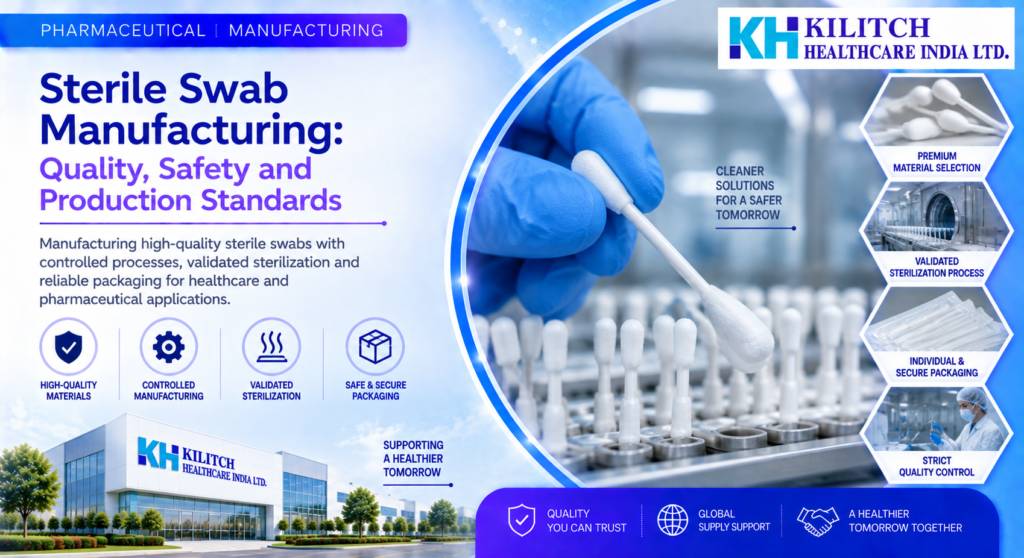
Understanding Sterile Swab Manufacturing Sterile swabs are important consumable products used across healthcare, pharmaceutical, laboratory, diagnostic, and clinical settings. Depending on their design and intended application, they can support specimen collection, wound care, preparation procedures, application of solutions, and other controlled medical processes. Sterile Swab Manufacturing involves several carefully controlled stages, including raw material selection, swab assembly, sterilization, packaging, inspection, and quality control. For B2B pharmaceutical and healthcare companies, understanding these processes is essential when evaluating suppliers and determining whether a particular swab meets the requirements of its intended application. Selecting an appropriate sterile swab manufacturer involves looking beyond production capacity. Buyers should also consider quality systems, material consistency, sterilization controls, packaging integrity, documentation, scalability, and the manufacturer’s ability to maintain consistent product specifications. Why Sterility Matters Sterility is a critical consideration for swabs intended for applications where unwanted microorganisms could affect a procedure, specimen, or product. A sterile swab must remain protected from contamination throughout manufacturing, packaging, transportation, storage, and distribution until the point of use. This requires an integrated approach in which manufacturing controls and packaging systems work together. Maintaining a controlled production environment, implementing appropriate process controls, and using validated sterilization methods can help manufacturers consistently achieve the defined requirements for sterile products. Materials Used in Sterile Swab Production The materials selected for a swab can influence its absorbency, strength, flexibility, sampling characteristics, and compatibility with the intended application. Material selection should therefore be based on clearly defined product specifications rather than simply focusing on cost. Cotton and Synthetic Tip Materials Sterile cotton swabs commonly use cotton fibers for their absorbent tips. Other swab designs may use synthetic materials such as rayon or polyester, depending on the intended purpose. Different materials can provide different absorption and release characteristics. For diagnostic or specimen-collection applications, manufacturers may need to consider factors such as specimen recovery, fiber shedding, chemical compatibility, and interaction with the testing process. Shaft and Applicator Materials The shaft is another important component of the swab. Depending on the intended application, manufacturers may use plastic, paper, or other suitable materials. Important characteristics can include flexibility, rigidity, dimensions, handling properties, and disposal requirements. The tip and shaft should ultimately be evaluated as an integrated product to ensure that the complete swab performs consistently. Key Stages in Sterile Swab Manufacturing The production of sterile swabs generally involves several interconnected stages. Maintaining consistency at each stage helps support the quality of the finished product. Raw Material Preparation Manufacturing begins with the selection and inspection of appropriate raw materials. Materials should be evaluated against established specifications before being released for production. Depending on the product, relevant characteristics may include dimensions, cleanliness, physical properties, absorbency, fiber characteristics, and material integrity. Strong incoming-material controls provide the foundation for consistent manufacturing and can help reduce variations during subsequent production stages. Swab Assembly During assembly, the absorbent tip is formed and attached securely to the shaft. Manufacturing parameters can vary according to the product design and materials being used. Consistency in tip dimensions, attachment, positioning, and overall construction is important. Variations in assembly can potentially influence the swab’s handling and intended performance. Automated or controlled production systems can help improve repeatability, particularly for commercial-scale production where large numbers of units need to meet the same specifications. Sterilization Swab sterilization is one of the most important stages when manufacturing products intended to be supplied as sterile. The selected sterilization method should be appropriate for the swab materials, packaging configuration, and intended product requirements. The process must be appropriately validated to demonstrate that it can achieve the required microbial control while maintaining the physical and functional characteristics of the swab. Manufacturers should also consider how sterilization conditions interact with the tip material, shaft, adhesives or attachment systems, and packaging components. Packaging Considerations for Sterile Swabs Packaging is an essential part of sterile product manufacturing because it provides protection after sterilization and during subsequent handling, transportation, and storage. Individual Sterile Packaging Individual packaging can help protect each swab from environmental exposure until it is opened for use. Depending on the product design, packaging formats may include pouches, peelable packs, or other suitable sterile-barrier configurations. The packaging format should be selected according to the product’s intended application, sterilization process, storage requirements, and distribution conditions. Package Integrity A sterilized product can only remain sterile if its protective packaging maintains its integrity. Manufacturers therefore need to evaluate sealing processes and packaging materials to ensure they provide an appropriate barrier throughout the intended shelf life. For B2B buyers, package integrity is an important factor when assessing the overall quality of a sterile swab product. Packaging should also be suitable for transportation and routine handling without compromising the sterile barrier. Quality Control in Sterile Swab Manufacturing Quality control should extend across every stage of production, from incoming raw materials to final product release. A comprehensive quality approach helps manufacturers identify potential deviations and maintain consistency between batches. In-Process Quality Checks In-process controls can include checks related to swab dimensions, tip attachment, material consistency, packaging operations, and other defined process parameters. These controls allow manufacturers to identify variations during production rather than relying solely on finished-product inspection. Finished Product Testing Finished products may undergo testing and inspection according to their specifications, intended application, regulatory requirements, and applicable standards. Depending on the product, evaluations may include visual inspection, dimensional checks, packaging integrity assessment, sterility-related testing, and other relevant quality attributes. Documentation of these activities is also important for B2B customers that require traceability, batch information, quality records, and supporting documentation. Selecting the Right Sterile Swab Manufacturer Choosing a supplier is a strategic decision for pharmaceutical, healthcare, and diagnostic companies. A capable supplier should be evaluated based on its manufacturing infrastructure, quality systems, technical expertise, production capacity, and ability to meet defined specifications. Evaluate Manufacturing Capabilities A prospective supplier should have appropriate systems for raw material management, controlled production, sterilization, packaging, quality control, and batch documentation. For companies looking for a broader manufacturing relationship, experience in pharmaceutical and healthcare production can also be valuable. The
Preservative-Free Ophthalmic Manufacturing: Key Considerations for Modern Eye Care
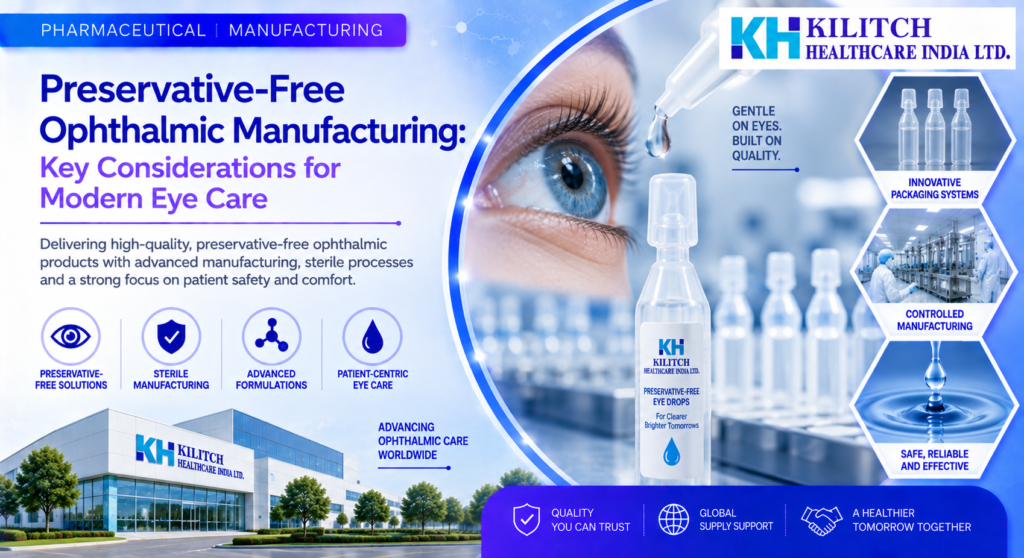
Why Preservative-Free Ophthalmic Manufacturing Matters Ophthalmic medicines are designed for direct application to sensitive ocular tissues, making product quality, sterility, compatibility, and consistency critical considerations throughout development and manufacturing. As pharmaceutical companies expand their eye-care portfolios, interest in preservative-free formulations has increased, particularly for products intended for frequent or long-term use. Preservative-Free Ophthalmic Manufacturing involves more than simply removing a preservative from an existing formulation. Manufacturers must consider formulation stability, microbiological safety, packaging compatibility, dosing performance, and the intended shelf life of the product. For pharmaceutical companies evaluating a manufacturing partner, choosing an organization with relevant capabilities can support a structured development and commercialization pathway. ophthalmic manufacturing is among the specialized areas addressed by Kilitch Healthcare. Understanding the Need for Preservative-Free Formulations Preservatives can serve an important function in certain multidose ophthalmic products by helping control microbial growth after opening. However, their suitability depends on the formulation, dosage form, container-closure system, intended use, and applicable regulatory requirements. Preservative-free products approach microbiological protection differently. Instead of relying on a preservative within the formulation, manufacturers may use suitable sterile manufacturing processes, specialized packaging systems, single-dose presentations, or appropriately designed multidose delivery technologies. The objective is to maintain product quality and microbiological integrity while delivering a formulation that meets its intended performance requirements. Key Challenges in Preservative-Free Ophthalmic Manufacturing Developing preservative-free ophthalmic products requires careful coordination between formulation science, manufacturing, packaging, quality assurance, and regulatory considerations. Maintaining Sterility and Microbiological Quality Sterility is a fundamental requirement for many ophthalmic dosage forms. Manufacturing environments, equipment, personnel practices, material handling, filling operations, and container-closure systems must be appropriately controlled to reduce contamination risks. For sterile eye drops manufacturing, process design should consider the entire product lifecycle, from preparation and filling through packaging and storage. Appropriate validation and microbiological controls are essential for demonstrating that the manufacturing process consistently produces products meeting established specifications. Ensuring Formulation Stability Removing a preservative may influence formulation characteristics. Developers need to assess physical and chemical stability, compatibility between ingredients, pH, osmolality, viscosity, appearance, and other relevant quality attributes. Ophthalmic formulation development therefore requires a systematic approach. The formulation must remain suitable throughout its proposed shelf life while maintaining the desired therapeutic and physical characteristics. Selecting the Right Packaging System Packaging plays an especially important role in preservative-free eye care. A suitable container-closure system needs to protect the formulation while supporting safe and convenient administration. For multidose products, the delivery system must be designed to help minimize contamination during repeated use. Depending on the product and target market, specialized dispensing technologies can provide an alternative approach to conventional preservative-containing multidose packaging. This makes packaging development an integral part of Preservative-Free Ophthalmic Manufacturing rather than an activity performed only after formulation development. The Role of Ophthalmic Manufacturing Technology Advances in ophthalmic manufacturing technology are creating new possibilities for pharmaceutical companies developing preservative-free products. Modern systems can combine controlled filling processes with specialized delivery mechanisms and packaging configurations. For example, Kilitch Healthcare highlights technologies including Novelia Pure Flow Technology and the 3K Triple Protection System on its official website. These technologies are presented as solutions designed to support preservative-free ophthalmic delivery through specialized packaging and dosing approaches. From Formulation to Delivery An effective ophthalmic product requires more than a suitable active pharmaceutical ingredient. The formulation, manufacturing process, container, closure, dispensing mechanism, and user experience must work together. For pharmaceutical companies, this integrated approach can be particularly valuable when developing preservative-free eye drops or other sterile ophthalmic products. Early consideration of the final delivery system can help ensure that formulation and packaging requirements remain aligned throughout development. Quality Considerations in Sterile Ophthalmic Manufacturing Quality control is central to ophthalmic drug manufacturing because the finished product must meet stringent requirements for its intended route of administration. Controlled Manufacturing Processes Sterile ophthalmic manufacturing requires appropriate environmental and process controls. Depending on the dosage form and manufacturing strategy, important considerations may include controlled cleanroom environments, sterilization or aseptic processing approaches, validated equipment, personnel controls, environmental monitoring, and appropriate in-process testing. Quality systems should also cover raw material controls, batch documentation, equipment qualification, process validation, analytical testing, and finished-product release. Consistency Across Commercial Batches For B2B pharmaceutical companies, consistency is just as important as successful product development. A formulation that performs well during laboratory or pilot development must be capable of being manufactured reproducibly at commercial scale. Manufacturing partners should therefore have appropriate systems for technology transfer, scale-up, process optimization, and ongoing quality monitoring. Kilitch Healthcare states that its manufacturing operations employ pharmaceutical GMP practices and that its broader manufacturing capabilities include ophthalmic formulations. Choosing a Partner for Ophthalmic Drug Manufacturing Selecting a manufacturing partner is a strategic decision for pharmaceutical companies planning to launch or expand an ophthalmic portfolio. The right partner should be evaluated across technical capabilities, manufacturing infrastructure, quality systems, development support, scalability, and regulatory readiness. Evaluate Development and Manufacturing Capabilities Companies should consider whether a prospective partner can support the complete product journey. This may include formulation development, analytical development, pilot batches, technology transfer, scale-up, commercial manufacturing, packaging, and quality documentation. A partner with experience across these areas can help create better coordination between development and manufacturing teams. Consider Specialized Ophthalmic Expertise Ophthalmic products have specific formulation and packaging requirements that differ from many other pharmaceutical dosage forms. Experience with sterile manufacturing, eye-drop delivery systems, ophthalmic suspensions, gels, or other ophthalmic presentations can therefore be valuable. Kilitch Healthcare identifies ophthalmic formulations as one of its manufacturing areas and operates an Eyekare Division focused on ophthalmic solutions and technologies. Benefits of a Structured Preservative-Free Development Approach A structured approach to Preservative-Free Ophthalmic Manufacturing can help pharmaceutical companies address technical and commercial requirements from the early stages of development. Better Alignment Between Formulation and Packaging When formulation and packaging decisions are evaluated together, developers can identify potential compatibility, stability, dosing, and contamination-control considerations earlier in the development process. Greater Flexibility for Product Portfolios Preservative-free technologies can support different ophthalmic product concepts depending on the active ingredient, dosage form, intended use, target market, and delivery requirements.
Pharmaceutical Facility Design: Principles, Planning and Compliance
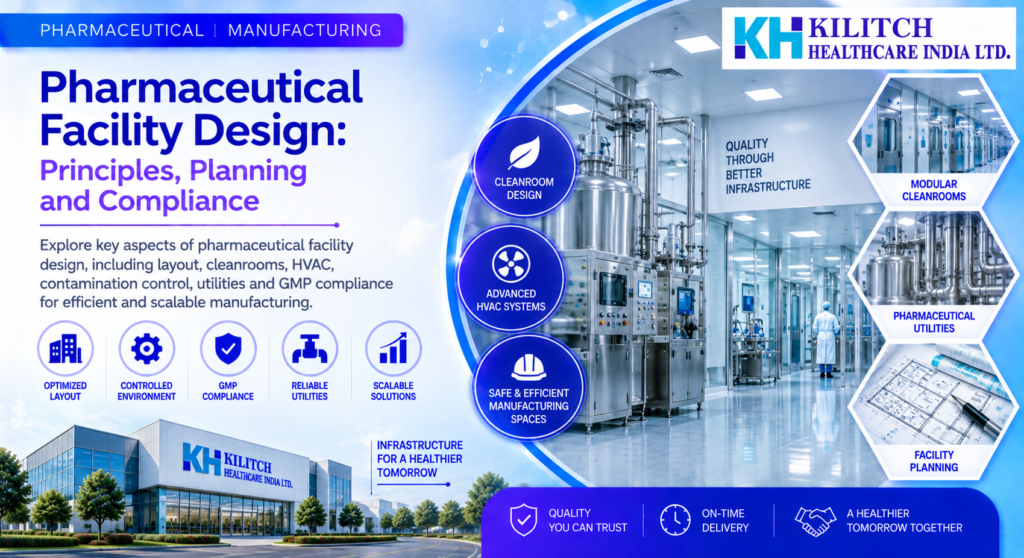
Understanding Pharmaceutical Facility Design Pharmaceutical Facility Design is the process of planning a manufacturing environment around product requirements, process flow, quality systems, personnel movement, material handling, utilities, environmental controls, and applicable regulatory expectations. A well-planned facility should support reliable production while making cleaning, maintenance, monitoring, qualification, and future modifications practical. For pharmaceutical companies, facility planning begins with understanding what will be manufactured and how it will be manufactured. Dosage form, production scale, equipment, raw materials, sterility requirements, packaging operations, storage conditions, and target markets can all influence the final layout. Early coordination between engineering, manufacturing, quality, validation, and regulatory teams helps ensure that infrastructure decisions support the intended operation. Organizations evaluating a new or expanded pharmaceutical manufacturing facility should consider the capabilities of potential manufacturing partners and their approach to controlled pharmaceutical production. Key Objectives of Pharmaceutical Facility Planning The primary objective of facility planning is to create a controlled environment that supports product quality and efficient operations. A facility should provide appropriate segregation, logical process flows, adequate utilities, controlled environmental conditions, and suitable areas for production and support functions. Design decisions should consider people and materials. Unnecessary movement can increase operational complexity and create additional contamination-control challenges. Clearly defined routes and appropriately positioned rooms can help personnel and materials move efficiently through the facility. Facility Layout and Process Flow A pharmaceutical plant layout should reflect the sequence of manufacturing activities. Areas for receiving, quarantine, dispensing, preparation, processing, filling, packaging, storage, and quality functions should be arranged according to the product and process requirements. Logical zoning can help separate activities with different environmental or operational requirements. Supporting spaces such as change rooms, airlocks, equipment preparation areas, waste handling points, and service corridors should be considered alongside production rooms rather than added later. Equipment placement should allow sufficient space for operation, cleaning, inspection, maintenance, and safe personnel access. The layout should avoid unnecessary obstructions that could interfere with cleaning or environmental control. Cleanroom Design and Environmental Control For products requiring controlled environments, cleanroom design is a central component of the facility. Room classifications should be established according to the manufacturing process and applicable requirements rather than applying identical conditions throughout the entire building. Cleanroom surfaces, doors, ceilings, floors, fixtures, and penetrations should be selected and detailed to support effective cleaning and maintenance. Areas where dust or contaminants could accumulate should be minimized through appropriate architectural design. Environmental monitoring can provide information about whether defined conditions remain within established limits. Depending on the operation, monitoring may include particles, microorganisms, temperature, humidity, pressure differentials, and other relevant parameters. HVAC and Pharmaceutical Utilities Pharmaceutical HVAC systems are essential for controlling air supply, filtration, temperature, humidity, pressure, and airflow. HVAC capacity and configuration should be developed according to room classification, process requirements, heat loads, occupancy, equipment, and contamination-control objectives. Utilities are equally important to facility performance. Depending on the manufacturing process, a facility may require systems for purified water, compressed air, gases, steam, electricity, drainage, environmental controls, and other services. Utility systems should be appropriately designed, monitored, maintained, and qualified. Critical utilities should be planned with reliability and maintainability in mind. Access for servicing should be possible without unnecessarily disrupting production or compromising controlled areas. GMP Facility Design and Contamination Control GMP facility design should support documented procedures, controlled operations, hygiene, cleaning, maintenance, traceability, and quality oversight. The facility should make it practical for personnel to follow established procedures consistently. Contamination control should be incorporated from the design stage. Potential sources include personnel, raw materials, equipment, air movement, waste, cleaning activities, and maintenance work. Segregation, pressure relationships, controlled access, appropriate material flow, and cleaning-friendly surfaces can contribute to an overall contamination-control strategy. For sterile operations, the facility may require additional controls around personnel gowning, material transfer, environmental monitoring, aseptic processing, and critical areas. The design should be developed together with the specific sterile manufacturing process. Personnel and Material Movement Personnel movement is an important consideration because people can introduce particles and microorganisms into controlled areas. Changing rooms, gowning areas, personnel airlocks, and access controls should be positioned according to the cleanliness requirements of each area. Material movement should follow defined pathways. Material airlocks, pass-through systems, staging areas, and controlled transfer procedures can help reduce unnecessary movement through critical production spaces. Where practical, personnel and material routes should be designed to minimize crossover and support a clear operational sequence. This can improve workflow while reinforcing the facility’s contamination-control strategy. Equipment, Maintenance and Cleanability Equipment should be selected and positioned with both production and maintenance in mind. Operators need adequate access for routine activities, while maintenance teams require safe access to components, utilities, and service points. Cleanability should be considered during equipment and room design. Gaps, inaccessible surfaces, poorly positioned utilities, and difficult-to-reach areas can make routine cleaning more complicated. Designing these features appropriately from the beginning can support consistent sanitation practices. Maintenance activities should be planned so that servicing does not unnecessarily disrupt controlled operations. Where required, equipment and utilities can be arranged to provide service access from suitable support areas. Qualification, Validation and Documentation A pharmaceutical facility must demonstrate that critical systems and environments operate according to approved requirements. Qualification activities may cover rooms, HVAC systems, utilities, equipment, environmental controls, and other critical infrastructure. Documentation should support the facility throughout its lifecycle. Design specifications, drawings, equipment information, procedures, qualification records, calibration data, maintenance records, environmental monitoring results, and change-control documentation are important parts of a controlled quality system. Changes to layouts, equipment, utilities, processes, or environmental conditions should be evaluated through appropriate change-control procedures. This helps determine whether additional qualification, validation, or regulatory assessment is required. Scalability and Future Expansion Pharmaceutical businesses may expand production volumes, introduce new products, or adopt different technologies over time. Facility design should therefore consider future requirements while maintaining appropriate segregation and environmental control. Planning for sufficient utility capacity, equipment access, storage, HVAC requirements, and flexible support areas can make future expansion more manageable. However, flexibility should be balanced with the need to maintain controlled flows and avoid unnecessary
Sterile Swab Manufacturing: Quality, Safety and Production Standards
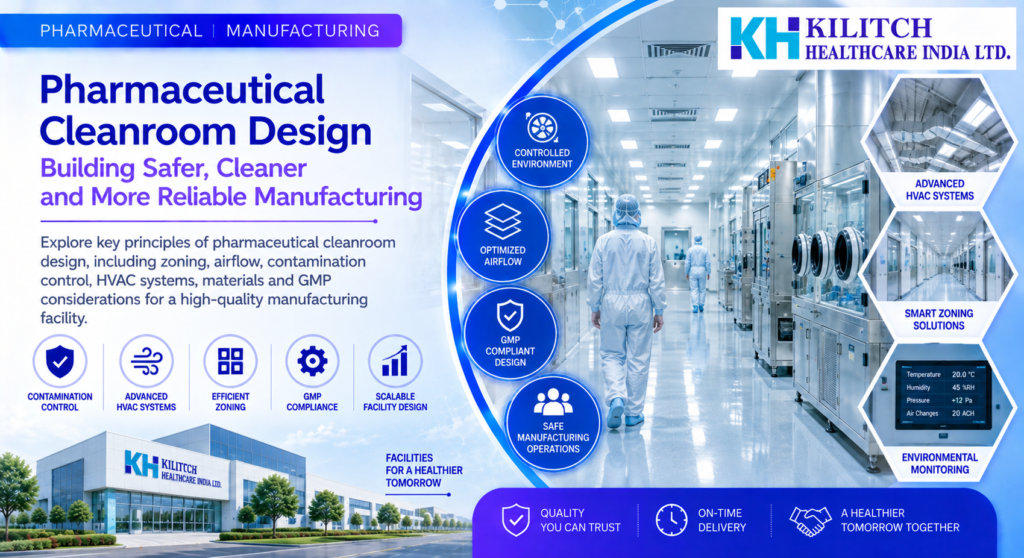
Understanding Pharmaceutical Cleanroom Design Pharmaceutical manufacturing depends on controlled environments that help protect products from contamination and support consistent quality. Pharmaceutical Cleanroom Design brings together facility layout, air handling, environmental controls, personnel movement, material flow, cleaning requirements, and equipment placement into one coordinated system. A well-planned cleanroom is designed around the manufacturing process rather than treated as an isolated construction project. Product type, dosage form, process steps, sterility requirements, equipment, batch size, and applicable regulatory expectations all influence the facility design. For pharmaceutical businesses, effective cleanroom planning can provide a structured foundation for manufacturing operations. It can also help organizations establish appropriate environmental controls while supporting efficient workflows, maintenance, cleaning, monitoring, qualification, and future expansion. Why Cleanroom Design Matters in Pharmaceutical Manufacturing The purpose of a pharmaceutical cleanroom is to control environmental conditions that may affect product quality. Depending on the manufacturing process, these conditions can include airborne particles, microorganisms, temperature, humidity, pressure differentials, and airflow patterns. Good design also reduces unnecessary movement and helps establish logical separation between activities. Personnel and materials can be directed through defined routes, while areas with different cleanliness requirements can be appropriately segregated. This approach is particularly important for sterile or contamination-sensitive products. Rather than relying only on end-product testing, facility design supports prevention and control throughout manufacturing. Key Elements of Pharmaceutical Cleanroom Design Several elements need to be considered together when developing a pharmaceutical cleanroom. The final configuration should reflect both manufacturing requirements and the facility’s contamination-control strategy. Facility Layout and Zoning Room layout and zoning establish the physical structure of the controlled environment. Different spaces may be allocated for raw material handling, dispensing, preparation, manufacturing, equipment cleaning, filling, packaging, storage, and personnel activities. Appropriate zoning can help separate processes with different environmental requirements and reduce unnecessary crossover. Corridors, airlocks, gowning areas, pass-through systems, and controlled access points should be positioned according to the intended flow of people and materials. The layout should provide sufficient access for cleaning, inspection, operation, and maintenance. Personnel and Material Flow Personnel are a significant potential source of contamination, making movement through controlled areas an important design consideration. Gowning rooms and personnel airlocks can support transitions between areas with different cleanliness requirements. Material movement should also follow defined pathways. Material airlocks, pass-through arrangements, staging areas, and controlled transfer procedures can help limit unnecessary movement through critical spaces. Separating personnel and material flows where appropriate can improve operational organization and support the overall contamination-control strategy. Cleanroom HVAC Systems and Airflow HVAC systems are fundamental to pharmaceutical cleanroom performance. Cleanroom HVAC systems help manage air supply, filtration, temperature, humidity, pressure, and airflow according to the requirements of each controlled area. Air filtration should be selected according to environmental conditions and process risks. Airflow patterns also need careful consideration because poorly designed airflow can create stagnant areas or undesirable movement of contaminants. Pressure differentials between rooms can help control the direction of air movement. The pressure cascade should be established according to the facility’s process and contamination-control requirements, then monitored during operation. GMP and Cleanroom Classification GMP cleanroom design should support the principles of controlled pharmaceutical manufacturing, including hygiene, documentation, process control, cleaning, maintenance, and quality assurance. The facility should provide an environment that allows procedures to be performed consistently and monitored effectively. Cleanroom classification should be determined according to the manufacturing process and applicable requirements. Different rooms may require different cleanliness levels depending on their function. Critical processing areas can require tighter environmental controls than supporting areas. Environmental monitoring programs may assess airborne particles, microorganisms, temperature, humidity, and pressure differentials as appropriate. Monitoring helps demonstrate that established environmental conditions remain within defined limits. Contamination Control and Surface Selection Contamination control should be considered from the earliest design stage. Personnel, raw materials, equipment, cleaning activities, and air movement can all influence the contamination risk within a facility. Walls, ceilings, floors, doors, and other surfaces should be selected to support routine cleaning and maintenance. Smooth, durable, and appropriately sealed surfaces can help reduce areas where contaminants may accumulate. Equipment placement is equally important. Equipment should be positioned to allow operation, cleaning, inspection, and maintenance without creating unnecessary obstructions. Utilities, penetrations, corners, and joints should also be designed with cleanability in mind. Designing a Sterile Manufacturing Facility A sterile manufacturing facility requires additional attention to microbial contamination control. Facility planning should consider controlled transitions between areas, personnel gowning, material transfer, equipment movement, environmental monitoring, cleaning, and the specific requirements of sterile processing. Where aseptic operations are involved, critical areas may require highly controlled environments and specialized technologies. The cleanroom should therefore be designed together with the process, equipment, and contamination-control strategy. Sterile facility design also needs to consider how environmental conditions will be maintained during routine operation, cleaning, maintenance, and interventions. These requirements should be addressed during design and facility qualification. Qualification, Validation and Ongoing Control Cleanroom performance must be demonstrated after construction and maintained throughout the facility lifecycle. Qualification activities can evaluate whether rooms, HVAC systems, equipment, and environmental controls operate according to approved specifications. Documentation is an important part of this process. Design specifications, equipment information, procedures, qualification records, monitoring results, maintenance records, and change-control documentation should be managed through the facility’s quality system. Ongoing control is equally important. HVAC performance, pressure differentials, environmental conditions, cleaning practices, calibration, and maintenance should be reviewed and monitored according to established procedures. Significant changes to layouts, equipment, processes, or environmental controls may require additional assessment. Planning for Scalability and Operational Efficiency Cleanroom design should consider both current manufacturing requirements and potential future needs. Pharmaceutical businesses may expand product portfolios, increase batch sizes, introduce new equipment, or modify processes over time. Planning for suitable utility capacity, equipment access, service areas, HVAC requirements, and flexible layouts can make future changes easier to manage. Flexibility should still be balanced against appropriate segregation and environmental control. Operational efficiency should also remain a design priority. Logical personnel routes, efficient material movement, accessible equipment, and well-planned support areas can reduce unnecessary movement and help manufacturing teams work more effectively.
Intravitreal Injection Manufacturing: Quality, Sterility and Safety
Understanding Intravitreal Injection Manufacturing Intravitreal injections are specialized ophthalmic drug products administered directly into the vitreous cavity of the eye. They are used when a medicine requires targeted ocular delivery, making product quality, sterility, formulation characteristics, dosage accuracy, and packaging particularly important. Intravitreal Injection Manufacturing involves a highly controlled process that can include formulation development, raw material qualification, aseptic processing, sterile filtration where appropriate, filling, container closure, inspection, packaging, and quality testing. Because these products are intended for intraocular administration, manufacturers must establish stringent controls throughout production. For pharmaceutical companies developing or commercializing intravitreal products, selecting an experienced intravitreal drug manufacturing partner requires careful consideration of sterile processing capabilities, quality systems, technical expertise, scalability, and documentation. Why Quality Is Critical Intravitreal products require a high level of control because they are administered directly into the eye. Product specifications should address attributes such as sterility, particulate matter, formulation stability, container-closure integrity, dosage accuracy, and other characteristics relevant to the finished product. Manufacturing processes should therefore be designed to minimize contamination risks while maintaining consistent product quality from batch to batch. Key Considerations in Intravitreal Injection Manufacturing Several technical areas require attention when developing and manufacturing intravitreal products. Formulation, filling, sterilization strategy, packaging, and quality control should be considered as interconnected elements. Intravitreal Formulation Development The formulation needs to maintain the required physical and chemical characteristics throughout manufacturing and the proposed shelf life. Depending on the active pharmaceutical ingredient and dosage form, developers may evaluate pH, osmolality, concentration, viscosity, stability, and compatibility with the selected container. Formulation development should also consider the intended route of administration and the characteristics of the active ingredient. Changes in excipient concentration, processing conditions, or container materials can affect stability and product performance, so these factors should be evaluated systematically. Aseptic Processing and Sterile Manufacturing Sterility is a fundamental requirement for products intended for intraocular administration. Sterile injectable manufacturing requires controlled environments, qualified equipment, trained personnel, appropriate gowning practices, environmental monitoring, and validated processes. Where applicable, sterile filtration may be incorporated into the manufacturing process. The selected approach depends on formulation characteristics, product compatibility, process design, and applicable requirements. Critical steps should be appropriately validated to demonstrate consistent performance. Aseptic manufacturing requires careful control of personnel and material movement. Facility zoning, air handling, cleaning, disinfection, and intervention practices should work together to reduce contamination risks during critical operations. Filling and Container-Closure Systems Filling operations must provide consistent dosage and minimize the risk of contamination or product loss. Equipment selection, filling parameters, component preparation, and process controls should be established according to the product and manufacturing strategy. Container-closure systems are particularly important for intravitreal products. Vials, syringes, or other presentations should be selected according to formulation compatibility, sterility maintenance, dose requirements, storage conditions, and intended use. Container-closure integrity testing can help demonstrate that the packaging system maintains its protective function throughout the proposed shelf life and distribution process. Quality Control in Intravitreal Drug Manufacturing Quality control should cover raw materials, in-process operations, environmental conditions, packaging components, and finished products. Testing requirements depend on the formulation, dosage form, applicable standards, and target market. Sterility and Particulate Control Sterility testing forms part of the overall quality strategy for sterile products, but sterility assurance depends on the complete manufacturing process rather than a single finished-product test. Environmental monitoring, process validation, equipment controls, and aseptic practices all contribute to the control strategy. Particulate control is another important consideration for injectable products. Manufacturing areas, components, equipment, containers, closures, and personnel practices should be managed to minimize the introduction of unwanted particles. Stability and Finished-Product Testing Finished-product evaluation may include assays, identification, impurities, pH, appearance, particulate matter, container-closure integrity, sterility-related testing, and other product-specific attributes. Stability studies help establish how product quality changes under defined storage conditions. Data from appropriate stability programs can support proposed shelf life and storage requirements. Packaging and Storage Considerations Packaging must protect the product from contamination and environmental exposure while supporting safe handling. Material compatibility is important because interactions between the formulation and container components can affect product quality. Storage conditions should be established based on product stability data and the characteristics of the formulation and packaging system. Clear labeling and controlled distribution practices are also important parts of the finished-product lifecycle. Selecting an Ophthalmic Manufacturing Partner Pharmaceutical companies evaluating an ophthalmic manufacturing partner should consider technical capabilities, quality systems, manufacturing infrastructure, validation practices, documentation, production capacity, and experience with sterile products. A partner supporting ophthalmic injectable manufacturing should be able to communicate clearly about formulation requirements, filling formats, component specifications, analytical testing, batch documentation, and commercial manufacturing plans. Scalability and Technology Transfer Technology transfer is an important stage when moving a product from development to commercial manufacturing. Manufacturing parameters, specifications, analytical methods, equipment requirements, and process knowledge should be transferred in a controlled manner. Scalability should be considered early. Equipment capacity, facility capabilities, component supply, production scheduling, and quality resources all influence the ability to increase output while maintaining consistent product quality. Role of Ophthalmic Pharmaceutical Manufacturing Specialized ophthalmic pharmaceutical manufacturing requires coordination between formulation science, sterile processing, engineering, quality assurance, analytical testing, and packaging. An integrated approach can help ensure that technical decisions made during development remain compatible with commercial production. For B2B pharmaceutical companies, early discussions with a manufacturing partner can help clarify product specifications, packaging options, production requirements, and quality documentation before commercialization. Regulatory and Documentation Considerations Documentation is a key component of pharmaceutical manufacturing. Product specifications, batch records, analytical procedures, equipment records, validation documents, environmental monitoring results, and quality records should be maintained according to the applicable quality system and market requirements. For companies preparing an intravitreal product for commercialization, regulatory expectations should be considered throughout development rather than only before launch. Early alignment between formulation, manufacturing, quality, and regulatory teams can help identify documentation and process requirements in advance. Process Control and Risk Management Process validation and risk assessment should be integrated into the manufacturing strategy. Critical process parameters and relevant quality attributes should be identified, monitored, and supported by appropriate evidence.
Unit Dose Ophthalmic Manufacturer in India: Precision, Sterility & Patient Safety
Unit Dose Ophthalmic Manufacturing: Supporting Safe, Precise Eye Care Ophthalmic medicines are applied directly to one of the body’s most sensitive organs, making sterility, dosing accuracy and packaging integrity essential. Unit-dose systems provide an individual container with a defined quantity of an ophthalmic formulation, helping reduce repeated handling and supporting controlled administration. For pharmaceutical companies developing or expanding eye-care portfolios, choosing a reliable Unit Dose Ophthalmic Manufacturer in India can be an important step toward consistent quality and scalable production. Unit-dose manufacturing brings together formulation expertise, controlled environments, precision filling, container selection, sealing and quality assurance. The approach must be matched to the formulation, fill volume, packaging requirements and intended market. A capable manufacturing partner can coordinate these elements so the finished product remains consistent throughout its defined shelf life. What Are Unit Dose Ophthalmic Products? Unit-dose ophthalmic products are supplied in individual containers intended to deliver a defined quantity of an eye-care formulation. Depending on the product and approved presentation, these may include single-use containers for suitable ophthalmic solutions and other preparations. The format can be especially relevant when preservative-free delivery is required or when minimizing repeated opening and handling is important. Unlike a conventional multi-dose bottle, an individual unit is designed around a single-use presentation, which can support convenience for patients and healthcare professionals. Unit-dose packaging is not simply a smaller version of a multi-dose bottle. Formulation characteristics, container material, filling method, closure system and packaging configuration must work together. Components also need to be compatible with the formulation and capable of protecting product quality during storage and distribution. Key Stages of Unit Dose Ophthalmic Manufacturing Producing a dependable unit-dose ophthalmic product requires a unit-dose ophthalmic production process. Each stage contributes to product quality, sterility and reliable performance. Formulation and Raw Material Control The process begins with qualified raw materials and a formulation developed against defined specifications. Parameters such as concentration, pH, osmolarity, viscosity and compatibility with the selected container system may need evaluation. Raw materials are verified before use, while controlled preparation supports batch-to-batch consistency. Aseptic Preparation and Processing Where aseptic manufacture is required, preparation and processing take place in controlled environments designed to minimize microbial and particulate contamination. Sterile filtration may be used where appropriate, and equipment, components and processing steps are managed through established procedures. Precision Filling Unit-dose containers require accurate and repeatable filling because each individual unit represents a defined quantity. Precision filling equipment and suitable process controls help maintain consistent fill volumes. In-process monitoring can identify deviations before they affect the wider batch. Sealing and Packaging After filling, individual units are sealed to protect the contents from external contamination. Packaging selection is therefore part of the product strategy. The finished presentation should be practical to handle while maintaining required protection during storage, transport and use. Inspection and Quality Control Quality activities help confirm that the finished product meets established specifications. Depending on the formulation and applicable requirements, testing may include sterility, particulate assessment, fill-volume verification, pH, stability and container-closure integrity evaluation. Batch records provide traceability from incoming materials through final release. Why Unit-Dose Packaging Matters in Ophthalmic Care Packaging has a direct role in protecting ophthalmic products because the formulation is exposed to the environment during administration. A well-designed unit-dose system can limit repeated opening, reduce unnecessary handling and provide a clearly defined quantity for use. For preservative-free formulations, unit-dose packaging can be a useful presentation because it does not depend on preservatives to protect a product after repeated opening. The container system therefore becomes an important part of the overall product design and must be considered alongside sterility, compatibility, usability and stability. Unit-dose presentations may also support differentiated product positioning in hospitals, clinics, surgical settings and other healthcare environments where individual formats are useful. The appropriate presentation should always be determined by the product’s formulation, intended use and applicable regulatory requirements. Important Quality Considerations for Unit Dose Ophthalmics Sterility Assurance Sterility is fundamental to ophthalmic manufacturing. Controlled environments, personnel practices, equipment and process controls must work together to minimize contamination risks. Sterilization or aseptic processing strategies should be established according to product requirements. Container Compatibility The container must be suitable for the formulation and should not adversely affect product quality. Material selection, interaction with the formulation and protection during storage are important development considerations. Dose and Fill Accuracy A unit-dose product should provide a consistent quantity. Filling systems therefore require suitable controls, calibration and monitoring to maintain repeatability across production. Packaging Integrity The seal and container system should protect the product throughout its shelf life and distribution. Inspection and integrity testing can help identify defects that may compromise product protection. Documentation and Traceability Robust records support quality oversight. Raw material records, manufacturing documentation, in-process checks, test results and release records should be maintained within the applicable quality system. How to Choose a Unit Dose Ophthalmic Manufacturer in India Selecting a manufacturing partner requires more than checking production capacity. Pharmaceutical companies should evaluate ophthalmic infrastructure, quality systems, technical expertise and experience with sterile products. Important areas include controlled manufacturing environments, aseptic filling capabilities, ophthalmic formulation expertise, packaging and inspection systems, quality control laboratories, stability support and documentation practices. It is also useful to understand the manufacturer’s approach to technology transfer, scale-up, batch planning and commercial supply. A strong partner should be able to address the complete product lifecycle rather than only the filling operation. Clear communication around specifications, responsibilities, timelines, quality agreements and regulatory expectations can make the manufacturing relationship more predictable and efficient. Unit Dose Ophthalmic Manufacturing at Kilitch Healthcare Kilitch Healthcare has an established focus on ophthalmic and sterile pharmaceutical manufacturing through its Eyekare Division. The company’s published ophthalmic capabilities include controlled manufacturing environments, aseptic processing, sterile filtration, specialized filling and quality control systems. Its sterile ophthalmic manufacturing information also identifies unit-dose vials among the container formats used for ophthalmic filling. This supports an integrated approach to ophthalmic unit-dose manufacturing. Kilitch also highlights technologies designed around preservative-free delivery and specialized ophthalmic packaging. Its published capabilities include multi-dose preservative-free systems, precision
