Some medicines are unstable in liquid form. They break down, lose potency or change chemically if stored as a solution. For these products, manufacturers supply the medicine as a sterile powder that is mixed with a liquid just before use.
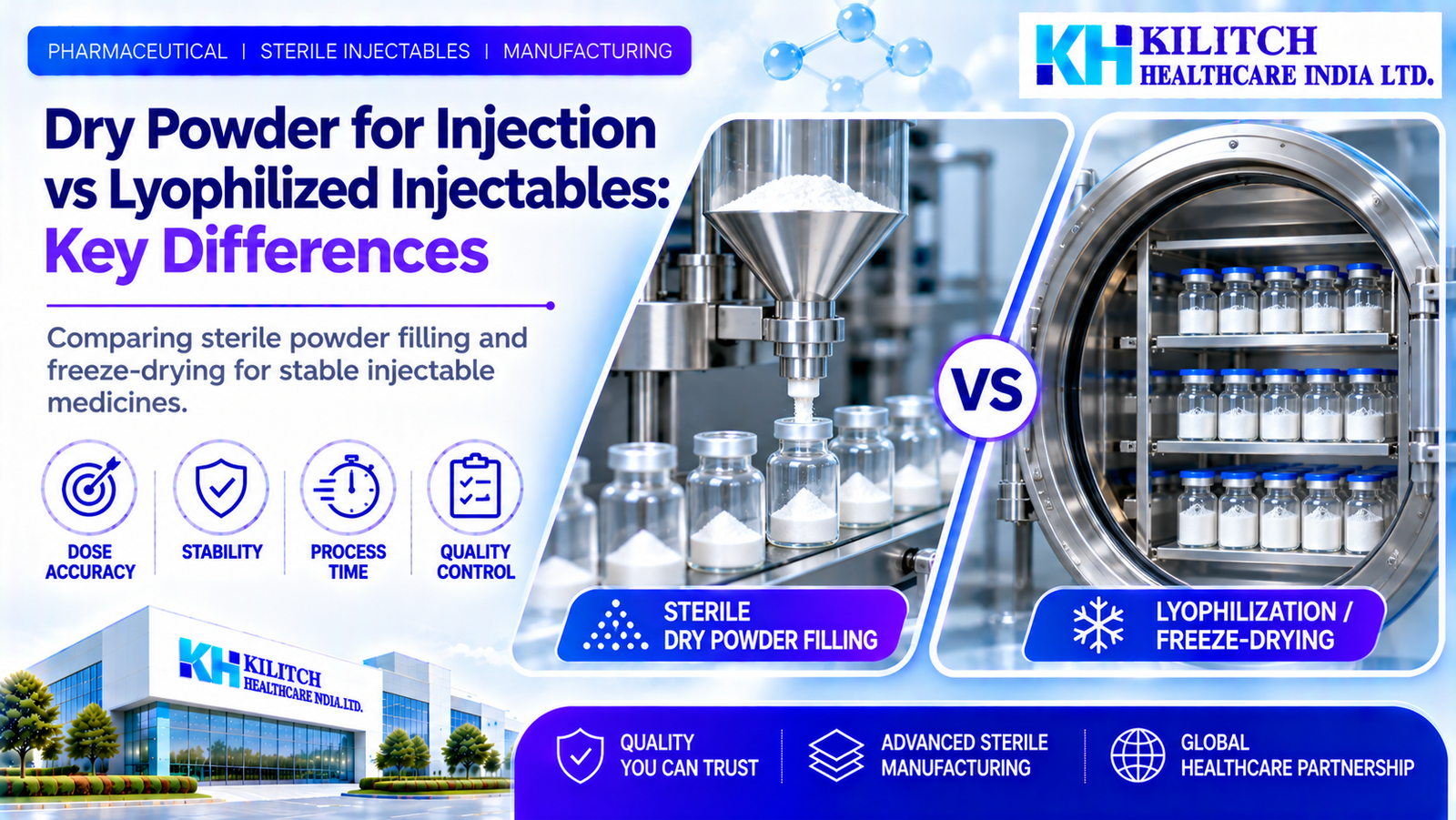
There are two main ways to make these powders: sterile dry powder filling and lyophilization, also called freeze-drying. Both create a powder in a vial, but the processes, costs and suitable products are quite different. This guide explains the differences to help brand owners and procurement teams understand which approach suits their medicine.
What Is a Dry Powder for Injection?
A dry powder for injection is made by filling a sterile, pre-made powder directly into sterile vials. The active ingredient is produced and sterilised as a powder beforehand, often by sterile crystallisation or spray-drying, and then weighed into each vial under aseptic conditions.
This approach is common for many antibiotics, such as certain penicillins and cephalosporins, which are stable as dry solids.
What Is a Lyophilized Injectable?
A lyophilized injectable starts as a liquid solution. The solution is sterile filtered, filled into vials and then placed into a freeze-dryer. The product is frozen, and water is removed under vacuum through sublimation, where ice turns directly into vapour. The result is a dry, porous cake that dissolves quickly when reconstituted.
Lyophilization is widely used for biologics, peptides, some antibiotics, oncology drugs and other sensitive medicines. Learn more in our guide to the lyophilized drug manufacturing process.
How the Processes Compare
Dry Powder Filling Process
- Sterile powder is produced and tested.
- Vials and stoppers are washed and sterilised.
- The powder is accurately weighed into vials using powder filling machines in an aseptic area.
- Vials are stoppered and sealed.
Lyophilization Process
- The drug solution is prepared and sterile filtered.
- The solution is filled into sterile vials, and stoppers are partially inserted.
- Vials are loaded into the freeze-dryer.
- The product is frozen, then dried under vacuum in primary and secondary drying stages.
- Stoppers are fully closed inside the freeze-dryer, and vials are sealed.
Side-by-Side Comparison
| Feature | Dry powder for injection | Lyophilized injectable |
| Starting material | Sterile powder | Liquid solution |
| Sterilisation method | Powder sterilised before filling | Solution sterile filtered |
| Dose accuracy | Depends on powder weighing | Very precise liquid filling |
| Process time | Faster | Longer drying cycles |
| Equipment cost | Lower | Higher, freeze-dryers are expensive |
| Suitable products | Stable solids, many antibiotics | Heat- and moisture-sensitive drugs, biologics |
| Appearance | Loose powder | Porous cake |
| Reconstitution | Usually quick | Usually very quick |
Advantages of Dry Powder Filling
- Lower manufacturing cost, as no freeze-drying cycle is needed.
- Faster production with shorter cycle times.
- Proven for antibiotics, especially beta-lactams.
Limitations
- Requires a sterile powder source, which can be difficult to produce.
- Weighing small doses of powder accurately is challenging.
- Powder handling can generate dust and needs careful containment.
Advantages of Lyophilization
- Ideal for sensitive molecules that cannot be produced as sterile powders.
- Precise dosing, because liquid is filled before drying.
- Excellent stability and long shelf life.
- Rapid reconstitution thanks to the porous cake structure.
Limitations
- Long cycle times, often a day or more.
- High equipment and energy costs.
- Cycle development requires expertise and careful validation.
For more, see why lyophilized injectable manufacturers are important.
How to Choose the Right Approach
Is a Sterile Powder Available?
If the active ingredient can be produced as a sterile, stable powder, dry powder filling may be the more economical route.
How Sensitive Is the Molecule?
Biologics, peptides and many complex drugs need lyophilization to stay stable.
What Is the Dose?
Very small doses are often easier to fill accurately as liquids, favouring lyophilization.
What Are the Cost Targets?
For high-volume, price-sensitive products, dry powder filling may offer advantages.
Quality Considerations for Both Formats
Both approaches require aseptic processing, validated sterilisation, environmental monitoring and strict testing. Key quality tests include sterility, moisture content, reconstitution time, content uniformity and particulate matter. Stability studies confirm that the product remains effective throughout its shelf life.
Packaging Considerations for Powder Injections
Both dry powder and lyophilized products are usually supplied in glass vials with rubber stoppers. The vial must withstand the process conditions, especially the extreme cold and vacuum of freeze-drying. Stoppers for lyophilized products are specially designed with venting channels, allowing water vapour to escape during drying before they are pushed fully closed. Container closure integrity is critical, because moisture entering the vial can reduce stability.
Some products are supplied with a matching diluent, either in a separate vial or ampoule. Kits that include both the powder and the diluent make preparation easier and help ensure the correct liquid is used for reconstitution.
Reconstitution and Use
Before administration, the powder must be reconstituted with a suitable liquid, such as sterile water for injection. Instructions specify the volume of diluent, how to mix and how long the solution can be stored after preparation. Lyophilized cakes usually dissolve quickly thanks to their porous structure, which is an advantage in busy hospital settings. Dry powders may need slightly more mixing, depending on particle size and solubility.
Healthcare professionals rely on clear instructions to prepare the correct dose safely, so well-written package leaflets are an important part of product quality.
Scaling Up Production
Scaling a lyophilization process from development to commercial batches requires careful work. Larger freeze-dryers behave differently from small laboratory units, so cycles are adjusted and validated at scale. For dry powder filling, larger batches require consistent powder flow and accurate weighing at high speed. An experienced manufacturer plans scale-up early, reducing the risk of delays when demand grows.
Market Trends
Demand for lyophilized injectables continues to grow as more complex and sensitive medicines are developed, including biologics and specialised hospital products. Dry powder filling remains important for established antibiotics and high-volume, cost-sensitive markets.
Questions to Ask Your Manufacturer
When discussing a powder injection project, ask whether the manufacturer has both dry powder filling and freeze-drying capability, how cycles are developed and validated, what batch sizes are possible and what stability data will be generated. These answers help you plan timelines and costs realistically.
Frequently Asked Questions
Do lyophilized products need special storage?
Many are stable at room temperature or under refrigeration as stated on the label, but they must be protected from moisture. Always follow the storage instructions.
Is a lyophilized product the same as a dry powder injection?
Both are powders in vials, but lyophilized products are made by freeze-drying a solution, while dry powder injections are filled directly as powder.
Why are lyophilized injectables more expensive?
Freeze-drying uses costly equipment and long processing cycles.
Which is better for antibiotics?
Many antibiotics use dry powder filling, but some are lyophilized depending on stability.
How long does lyophilization take?
Cycles vary widely depending on the product, from many hours to several days.
Work with a Lyophilized Injectable Manufacturer
Kilitch Healthcare is an experienced lyophilized injectable manufacturer supporting partners in India and overseas. Contact us to discuss your product requirements.