Injectable medicines go directly into the bloodstream, muscles or tissues, bypassing the body’s natural defences. That is why they must be free from microorganisms and also free from visible and sub-visible particles. Even a tiny fragment of glass, fibre or rubber can cause harm or lead to a product recall.
For a sterile injectable pharmaceutical company, preventing and detecting particles is one of the most demanding parts of quality assurance. This article explains where particles come from, how they are prevented and how every unit is inspected before release.
What Is Particulate Matter?
Particulate matter refers to unwanted, undissolved particles in an injectable product. They are generally grouped into:
- Visible particles, which can be seen with the naked eye under suitable inspection conditions.
- Sub-visible particles, which are too small to see but can be counted using specialised instruments.
Particles may be extrinsic, coming from outside the process, or intrinsic, coming from the product, packaging or equipment.
Common Sources of Particles
| Source | Examples |
| Environment | Airborne dust, fibres from clothing |
| Packaging | Glass fragments, rubber from stoppers, coating flakes |
| Equipment | Metal from machinery, wear from seals and tubing |
| Product | Precipitates, undissolved material, protein aggregates |
| People | Skin flakes, hair, fibres |
Understanding these sources is the first step in controlling them.
Preventing Particles: Control at Every Stage
Inspection is important, but the best approach is to stop particles from entering the product in the first place.
Cleanroom Design and Air Quality
Sterile injectables are manufactured in classified cleanrooms with HEPA-filtered air. Critical filling zones operate under the highest air cleanliness grades, with controlled airflow that sweeps particles away from open containers. Learn more about pharmaceutical facility design.
Personnel Practices
People are one of the largest sources of particles. Operators wear sterile cleanroom garments, follow strict gowning procedures and are trained in aseptic behaviour, including slow, controlled movements.
Component Preparation
Vials, ampoules and stoppers are washed, depyrogenated or sterilised using validated processes that also remove particles. Suppliers are qualified and their materials are tested.
Filtration
Solutions are filtered through validated sterilising-grade filters, which remove particles as well as microorganisms.
Equipment Maintenance
Machines are designed for cleanroom use and maintained to prevent wear. Regular checks help identify parts that could shed particles.
How Visual Inspection Works
Even with excellent controls, every unit of a sterile injectable is inspected before release.
Manual Visual Inspection
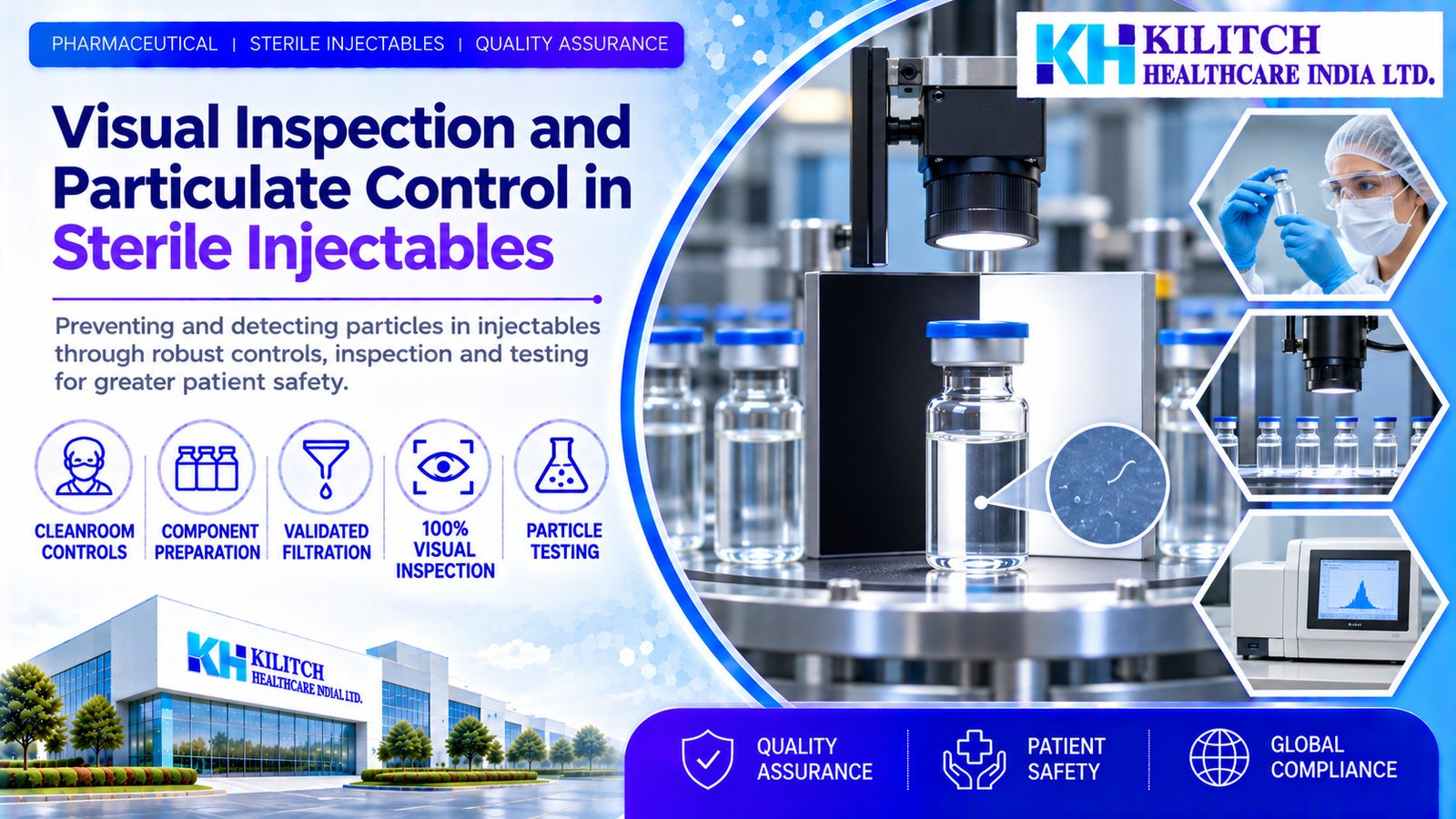
Trained inspectors examine each container against black and white backgrounds under controlled lighting. They gently swirl or invert the container to make particles move and become visible. Inspectors also check for cracks, fill level, cosmetic defects and sealing problems.
Manual inspection depends heavily on people, so inspectors are trained, qualified using test sets containing known defects, and given regular breaks to avoid fatigue.
Semi-Automated Inspection
In semi-automated systems, machines rotate and present containers to inspectors, improving consistency while still relying on human judgement.
Automated Inspection
Automated systems use high-resolution cameras and software to inspect containers at high speed. They can detect particles, cracks and fill level variations consistently. Automated systems are validated to show they detect defects at least as well as qualified human inspectors.
Sub-Visible Particle Testing
Sub-visible particles cannot be seen during visual inspection, so samples from each batch are tested in the laboratory using light obscuration or microscopic methods. Results must meet pharmacopoeial limits before the batch can be released.
Acceptable Quality Limits and Batch Decisions
After 100% inspection, a sample of accepted units is often re-inspected to confirm the inspection was effective. If defect rates are higher than expected, the batch is investigated. Root cause analysis helps identify whether the issue came from components, equipment, the environment or the process.
Why Particulate Control Matters for Patients and Brands
- Patient safety. Particles can block small blood vessels, cause inflammation or trigger immune reactions.
- Regulatory compliance. Regulators expect robust particle control and 100% inspection of injectables.
- Brand reputation. Particle-related recalls can damage trust with doctors, hospitals and regulators.
- Market access. Export markets often audit inspection systems closely.
Read more about how pharmaceutical manufacturers ensure medicine safety.
Continuous Improvement
Leading manufacturers track defect trends, investigate recurring issues and work with suppliers to improve component quality. Inspection data becomes a valuable tool for improving processes over time.
Training and Qualifying Inspectors
Human inspectors are central to most inspection programmes, and their performance must be proven. Inspectors are trained to recognise different defect types, then qualified using standard test sets containing known good units and units with defects such as particles, cracks and fill errors. They must detect defects reliably before they are allowed to inspect production batches. Requalification is carried out regularly, and inspectors also undergo eye tests to confirm good vision.
Inspection rooms are designed to support accuracy, with controlled lighting intensity, suitable backgrounds and minimal distractions. Time limits per container and regular breaks help prevent fatigue, which can reduce detection rates.
Defect Classification
Defects found during inspection are usually classified by their potential impact:
- Critical defects could harm patients, such as particles, cracks or missing seals.
- Major defects could affect product performance or usability, such as incorrect fill volume.
- Minor defects are cosmetic and do not affect safety or performance.
Each category has its own acceptance limits, and critical defects are treated with the highest level of scrutiny.
Working with Component Suppliers
Many particles originate from packaging components. Manufacturers work closely with suppliers of glass vials, ampoules and rubber stoppers, sharing defect data and agreeing quality specifications. Ready-to-use components, which arrive washed and sterilised, can reduce the risk of particles from component preparation.
The Role of Technology
Advances in camera systems, lighting and software are making automated inspection more accurate and flexible. Some systems can now distinguish between real particles and harmless air bubbles more reliably than before, reducing false rejects. Even so, technology works best alongside skilled people who understand the process and can investigate unusual results.
Inspection and Patient Trust
Doctors, nurses and patients rarely see the inspection process, but they rely on it every time they use an injectable medicine. A consistent, well-run inspection programme is one of the clearest signs of a manufacturer’s commitment to quality, and it is an area buyers should always review during audits.
Frequently Asked Questions
How are inspectors qualified?
They are trained and tested using standard sets of containers with known defects, and must detect them reliably before inspecting production batches.
Why must every injectable unit be inspected?
Particles can occur randomly, so inspecting every unit is the most reliable way to protect patients.
What is the difference between visible and sub-visible particles?
Visible particles can be seen during inspection, while sub-visible particles are smaller and must be measured with laboratory instruments.
Is automated inspection better than manual inspection?
Automated systems offer speed and consistency, but both methods can be effective when properly validated.
What happens if particles are found in a batch?
Affected units are rejected, and the batch is investigated to find and correct the root cause.
Quality You Can Trust
As a sterile injectable pharmaceutical company, Kilitch Healthcare places particle prevention and inspection at the heart of its quality systems. Contact us to learn more about our injectable capabilities.