Introduction: Why Ophthalmic Suspensions Require Specialized Manufacturing
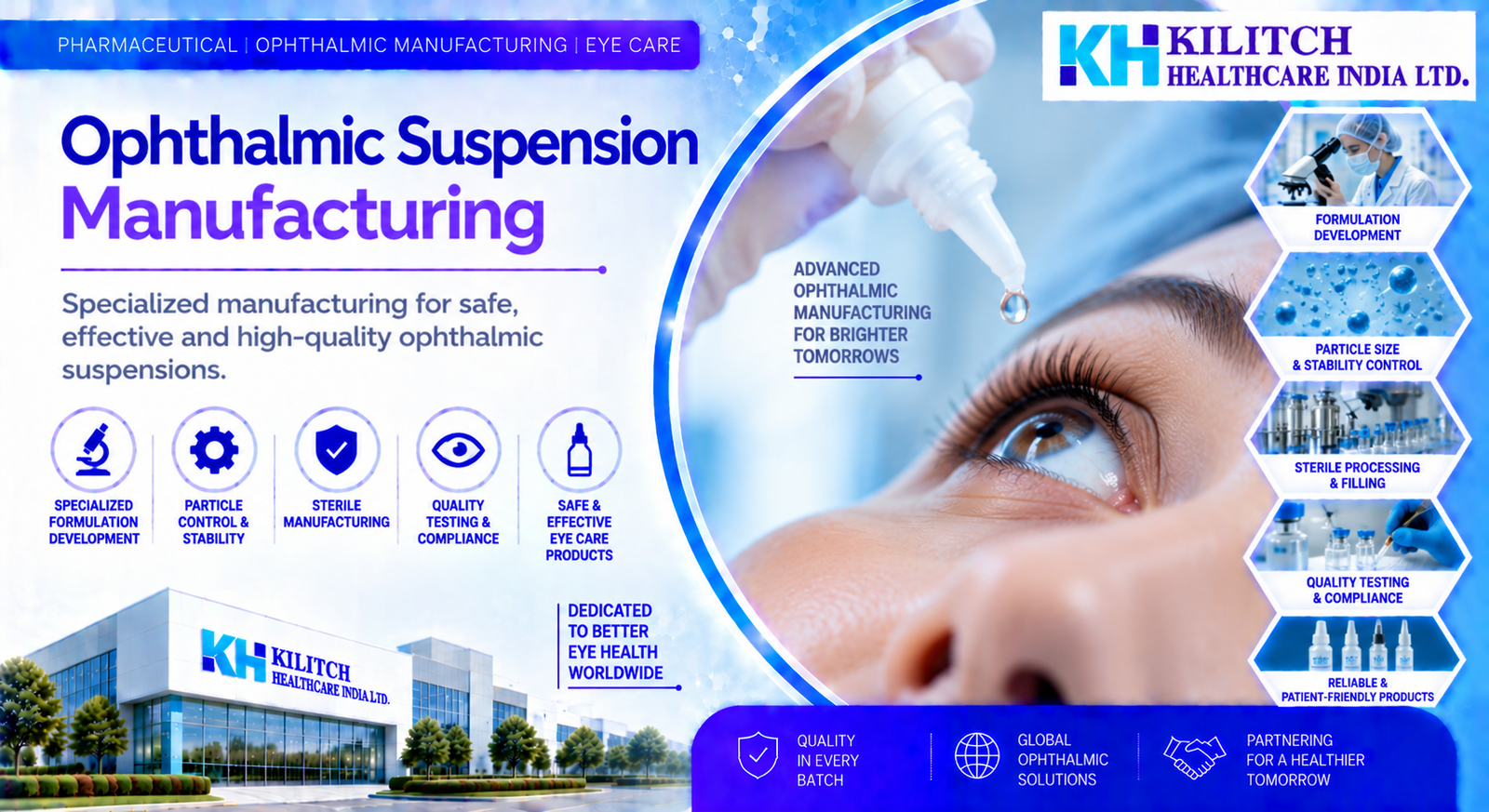
Ophthalmic suspension manufacturing involves the controlled production of sterile eye products in which finely divided drug particles are dispersed within a suitable liquid vehicle. Unlike a simple ophthalmic solution, a suspension contains insoluble or sparingly soluble particles, making particle characteristics, uniformity, sterility, resuspendability and dose delivery important considerations. Kilitch Healthcare works across specialized ophthalmic formulations, making an integrated approach to formulation, sterile processing, filling and quality control particularly relevant for these products.
What Is an Ophthalmic Suspension?
An ophthalmic suspension is a sterile liquid dosage form containing drug particles that are dispersed rather than completely dissolved. The formulation is designed so the particles remain suitably distributed during handling and can be resuspended when required. Its performance depends on the properties of the active ingredient, excipients, particle size, vehicle and container system.
Because the product is intended for ocular administration, development must consider both pharmaceutical performance and patient safety. The formulation needs to maintain appropriate physical characteristics during storage while supporting consistent administration. This makes ophthalmic suspension development a combination of formulation science, sterile manufacturing and product-specific quality control.
Key Considerations in Ophthalmic Suspension Manufacturing
Particle Size and Distribution
Particle characteristics can influence the physical stability and performance of an ophthalmic suspension. Particle size distribution, morphology and surface properties may affect sedimentation, redispersibility and the consistency of the administered dose. Development teams therefore need to establish suitable particle characteristics for the specific drug product.
Suspension Stability
A suspension naturally tends to settle over time, so the formulation must be designed to support appropriate physical stability and easy redispersion. Vehicle properties, suspending agents and other excipients can influence how particles behave during storage. Stability studies help establish whether the formulation continues to meet its defined requirements throughout its intended shelf life.
Sterility and Microbial Control
Sterility is fundamental for ophthalmic products. Manufacturing controls must address the risk of microbial contamination across formulation preparation, processing, filling, container closure and finished-product handling. Facility controls, validated procedures, environmental monitoring and appropriate testing work together to support the required sterility assurance.
Ophthalmic Suspension Manufacturing Process
1. Raw-Material and Active-Ingredient Preparation
The manufacturing process begins with controlled handling of the active pharmaceutical ingredient and excipients. Material identity, quality and suitability are established against approved specifications. For a suspension, the physical characteristics of the active ingredient can be particularly important because they directly influence dispersion and product performance.
2. Particle Processing and Dispersion
The active ingredient may require appropriate particle processing before it is incorporated into the formulation. The objective is to achieve the desired particle characteristics and distribute the drug uniformly throughout the vehicle. Mixing parameters, order of addition and processing conditions need to be established according to the product.
3. Formulation Preparation
The formulation is prepared using controlled procedures for the vehicle, excipients and active ingredient. Parameters such as mixing time, temperature, concentration and processing sequence may affect suspension quality. Consistent process control helps reduce variability between batches and supports reproducible product characteristics.
4. Sterile Processing and Filling
Once the formulation is ready, the product is processed and filled under suitable controlled conditions. Depending on the formulation and manufacturing strategy, filtration or other product-specific controls may be used where appropriate. Filling accuracy, container handling and equipment performance are important for maintaining consistent product quality.
5. Stoppering, Inspection, and Packaging
After filling, containers are closed using the specified closure system and inspected according to established requirements. Packaging protects the product during storage, transportation and handling. The container and closure must also remain compatible with the formulation and support product integrity throughout its intended shelf life.
Quality Control in Ophthalmic Suspension Manufacturing
Assay and Content Uniformity
Analytical testing helps confirm that the drug product contains the intended amount of active ingredient and meets established specifications. For a suspension, sampling and testing approaches should account for the dispersed nature of the formulation so that product uniformity can be evaluated appropriately.
Particle and Physical Characteristics
Physical testing can evaluate characteristics relevant to suspension performance, including particle size, appearance, redispersibility and other product-specific attributes. These assessments help determine whether the formulation remains within its defined quality profile during development and stability testing.
Sterility and Safety Testing
Ophthalmic products require appropriate microbiological and quality controls. Testing and environmental monitoring are used alongside controlled manufacturing practices to verify that the product and process meet established requirements. The exact testing programme depends on the product and applicable specifications.
Formulation Development Challenges
Developing an ophthalmic suspension can involve balancing several formulation requirements at once. The product must maintain suitable particle characteristics, remain adequately dispersed, support acceptable administration and retain stability during storage. Changes to one component can influence other properties, so formulation optimization requires a systematic development approach.
Container and delivery considerations are also important. The selected bottle, dropper or other delivery configuration should work with the suspension and help provide consistent administration. Compatibility studies can help identify potential interactions between the formulation and packaging materials before commercial production.
Why Integrated Ophthalmic Manufacturing Matters
Ophthalmic suspension manufacturing requires close coordination between formulation development, sterile processing, filling, analytical testing and packaging. An integrated pharmaceutical manufacturing approach can help connect these activities and reduce the risk of development decisions creating challenges during commercial production.
This becomes especially important when a formulation moves from laboratory or pilot work into routine manufacturing. Equipment characteristics, batch size, process controls and material handling can change with scale. Early consideration of manufacturing requirements can therefore support a more controlled transition to commercial supply.
Choosing an Ophthalmic Manufacturing Partner
Companies evaluating an ophthalmic manufacturing partner should consider more than basic production capacity. Relevant factors include experience with sterile ophthalmic formulations, formulation-development support, particle and suspension expertise, filling capabilities, analytical testing, quality systems and packaging knowledge.
A partner with experience across these areas can help align product development with manufacturing requirements. For businesses exploring ophthalmic pharmaceutical manufacturing, reviewing the manufacturer’s formulation and production capabilities can help determine whether its infrastructure is appropriate for the intended product.
Ophthalmic Suspension Manufacturing at Kilitch Healthcare
Kilitch Healthcare works across specialized pharmaceutical categories, including ophthalmic formulations, sterile injectables, nasal formulations and prefilled syringes. Its broader pharmaceutical platform combines research and development, manufacturing and quality functions, allowing product-specific requirements to be considered across the development and production pathway.
For an ophthalmic suspension, this integrated environment can support the coordination of formulation characteristics, sterile manufacturing, filling, testing and packaging. The specific process and controls remain dependent on the product, but the ability to connect these functions is important when developing a reliable ophthalmic dosage form.
Conclusion: Building Consistent Ophthalmic Suspensions
Ophthalmic suspension manufacturing requires careful control of particle characteristics, formulation stability, sterility, filling, packaging and finished-product quality. Because these factors are closely connected, successful development depends on understanding the product from formulation through commercial manufacturing. Kilitch Healthcare provides specialized pharmaceutical manufacturing capabilities that include ophthalmic formulations, offering an integrated environment for businesses evaluating ophthalmic product development and manufacturing requirements.