India supplies medicines to patients in nearly every country, which makes the quality of Indian manufacturing a global concern. To bring domestic standards closer to international expectations, the government revised Schedule M of the Drugs and Cosmetics Rules, the part of the law that sets Good Manufacturing Practice (GMP) requirements for pharmaceutical units.
For pharma buyers, brand owners and importers, these changes matter. They affect which manufacturers can operate, how facilities are run and what quality evidence you can expect. This guide explains revised Schedule M in plain language and what it means when you choose a GMP certified pharmaceutical company.
What Is Schedule M?
Schedule M sets out the GMP requirements that every licensed pharmaceutical manufacturer in India must follow. It covers premises, equipment, personnel, documentation, production, quality control and more. Older versions were criticised for not fully matching global standards such as those of the World Health Organization.
The Revision and Its Timeline
The revised Schedule M was notified in December 2023 to align Indian GMP more closely with WHO standards. Larger manufacturers, those with turnover above ₹250 crore, were given a shorter period to comply. Micro, small and medium enterprises were given more time, and their deadline was later extended to 31 December 2025 on condition that they submitted upgrade plans.
As a result, revised Schedule M now applies to pharmaceutical manufacturing units across India from 1 January 2026, and state regulators have been carrying out inspections.
What Changed Under Revised Schedule M?
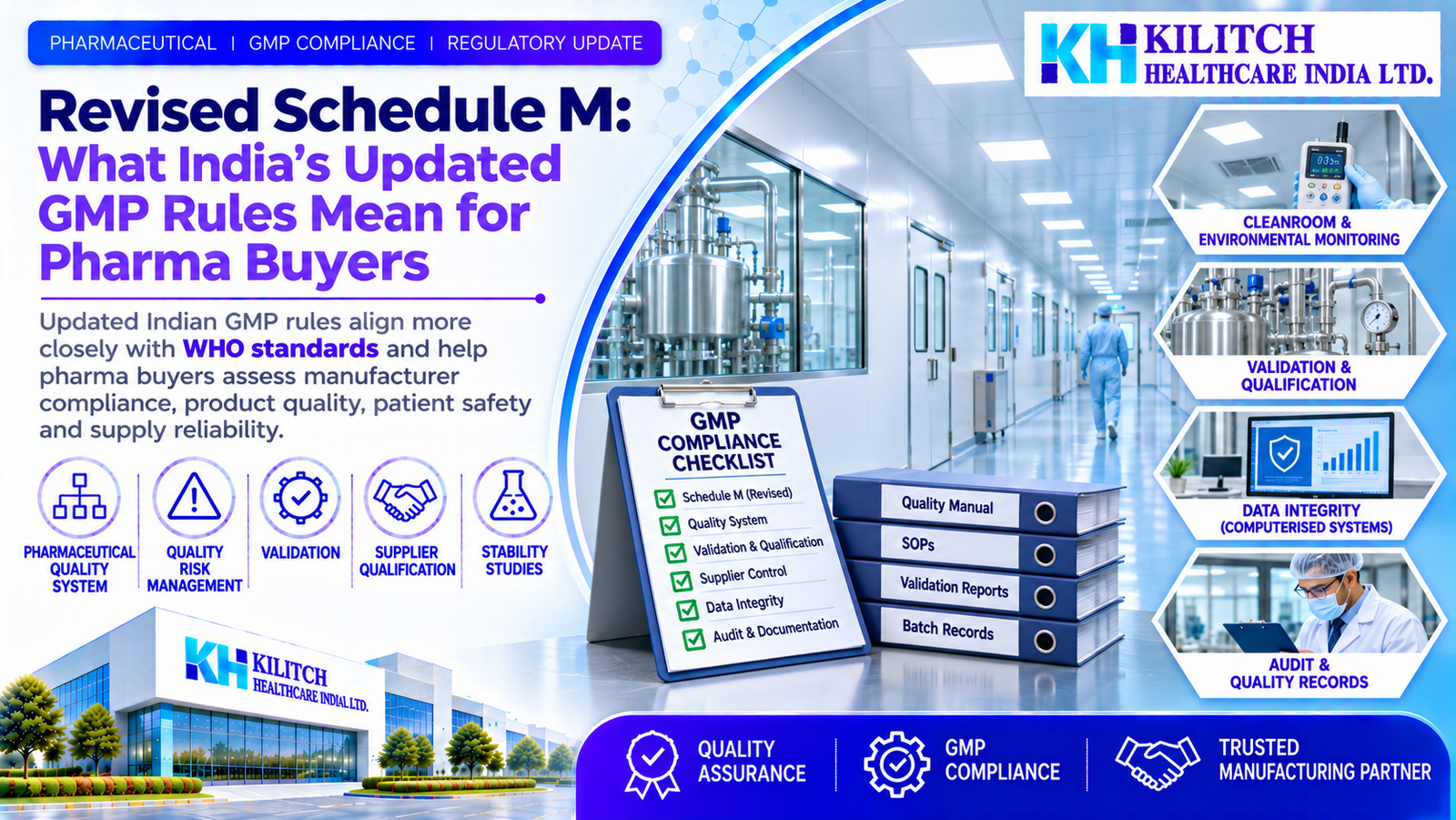
Pharmaceutical Quality System
Manufacturers must operate a formal Pharmaceutical Quality System, covering the entire product lifecycle, with clear management responsibility for quality.
Quality Risk Management
Companies must identify, assess and control risks to product quality, using a structured, documented approach.
Product Quality Review
Regular reviews of each product’s quality data are required, helping identify trends and improvement opportunities.
Validation and Qualification
Greater emphasis on qualifying equipment and validating processes, cleaning methods, analytical methods and computerised systems.
Supplier Qualification
Manufacturers must qualify and monitor suppliers of raw materials and packaging.
Stability Studies
Stronger requirements for stability programmes to support shelf life claims.
Computerised Systems
Requirements for validation and data integrity of computerised systems used in manufacturing and quality.
Sterile Product Requirements
More detailed expectations for sterile manufacturing, including cleanroom classification, environmental monitoring and aseptic process controls.
Why Revised Schedule M Matters to Buyers
| Buyer concern | How revised Schedule M helps |
| Product quality | Stronger quality systems and validation |
| Patient safety | Better contamination control and risk management |
| Export readiness | Closer alignment with WHO standards |
| Supply reliability | Better documented, more controlled processes |
| Reputation | Lower risk of quality failures linked to your brand |
How to Check a Manufacturer’s Compliance
When evaluating a manufacturing partner, ask for:
- Current manufacturing licences for the products you need.
- Evidence of revised Schedule M compliance or the latest inspection outcome.
- WHO-GMP certification, where applicable. Learn about the importance of GMP and WHO-GMP certification.
- Quality system documents, such as the quality manual and key procedures.
- Validation status of critical equipment, processes and utilities.
- Recent audit history, including customer and regulatory audits.
- A site visit or audit, which remains the best way to judge compliance.
Revised Schedule M and WHO-GMP: How Do They Relate?
WHO-GMP is an internationally recognised standard, and many Indian exporters have held WHO-GMP certification for years. Revised Schedule M brings national requirements closer to WHO-GMP, so manufacturers already operating at WHO-GMP level are generally better placed. For buyers, choosing a partner with both strong Schedule M compliance and WHO-GMP certification offers extra confidence.
What This Means for Small Brands and Marketers
If you rely on third-party or contract manufacturers, revised Schedule M makes partner selection more important than ever. Manufacturers that have not upgraded may face regulatory action, which could disrupt your supply. Working with established, compliant partners helps protect your brand and your customers.
What Manufacturers Had to Upgrade
For many units, meeting revised Schedule M meant real investment. Common areas of work included:
- Facility upgrades to improve cleanroom design, airflow, pressure differentials and segregation of activities.
- Utility systems such as purified water, water for injection and HVAC, with better monitoring and validation.
- Laboratory improvements, including qualified instruments, stability chambers and data integrity controls.
- Documentation systems covering procedures, records and change control.
- Training programmes to ensure staff understand and follow GMP requirements.
Structural changes, such as redesigning production areas, were often the most challenging, especially for older facilities.
Data Integrity Under Revised Schedule M
Data integrity has become a major focus for regulators worldwide. Revised Schedule M expects manufacturers to ensure records are attributable, legible, contemporaneous, original and accurate. In practice, this means secure computerised systems, audit trails, controlled access and regular review of data. For buyers, strong data integrity gives confidence that test results and batch records can be trusted.
Impact on the Indian Pharma Industry
The revised rules are expected to strengthen India’s reputation as a reliable source of quality medicines. Some smaller units have faced difficulty meeting the new standards, which may lead to consolidation in the industry. For buyers, this makes partner selection even more important. Working with manufacturers that invested early in quality systems reduces the risk of supply interruptions caused by regulatory action.
Building a Quality Agreement with Your Manufacturer
A written quality agreement should reflect revised Schedule M expectations. It should define responsibilities for supplier qualification, change control, deviations, product quality reviews, stability studies and complaint handling. Clear agreements help both parties meet their obligations and respond quickly if issues arise.
A Positive Step for Patients
Although compliance requires effort and investment, revised Schedule M is ultimately good news for patients and buyers. Stronger quality systems reduce the risk of contaminated or substandard medicines reaching the market, and closer alignment with WHO standards supports India’s role as a trusted global supplier. For brand owners, partnering with compliant manufacturers is now both a regulatory necessity and a competitive advantage.
Looking Ahead
Regulatory standards will continue to evolve. Manufacturers that treat GMP as a culture rather than a checklist will adapt more easily to future changes. Buyers should look for partners that invest steadily in people, systems and facilities, not just to pass inspections but to deliver consistent quality.
Frequently Asked Questions
What happens to manufacturers that do not comply?
Regulators can take action, including suspension or cancellation of licences, which is why buyers should confirm their partners’ compliance status.
What is revised Schedule M?
It is the updated set of GMP requirements for pharmaceutical manufacturers in India, aligned more closely with WHO standards.
When did revised Schedule M come into force?
It was notified in December 2023, and after extensions for smaller units, it applies to pharmaceutical manufacturing units across India from 1 January 2026.
Is revised Schedule M the same as WHO-GMP?
They are not identical, but revised Schedule M brings Indian requirements much closer to WHO-GMP.
Why should buyers care about Schedule M?
It affects product quality, supply reliability and the regulatory standing of the manufacturers you depend on.
Choose a Compliant Partner
Kilitch Healthcare is a GMP certified pharmaceutical company committed to high quality standards. View our accreditations and certificates or contact us to learn more.