Many sterile medicines, including most eye drops and many injectables, cannot be sterilised once they are in their final container. Heat or radiation would damage the medicine. Instead, they are made through aseptic processing: sterile ingredients are combined and filled into sterile containers in a controlled environment, so contamination never gets in.
But how does a manufacturer prove that its aseptic process really works? The answer is the media fill study, also known as aseptic process simulation. It is one of the most important validation activities in aseptic pharmaceutical manufacturing.
What Is a Media Fill Study?
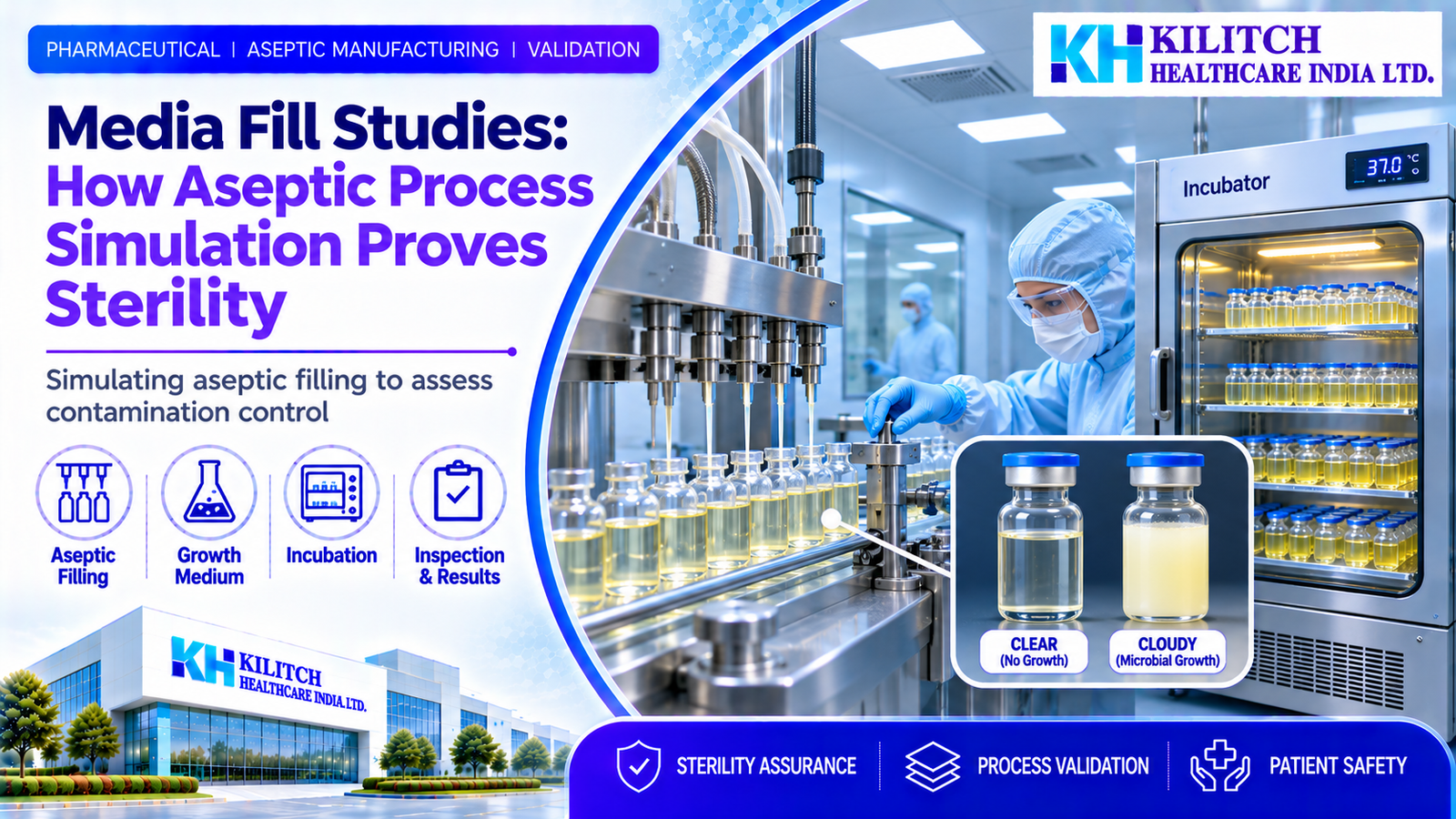
A media fill study is a simulation of the aseptic manufacturing process. Instead of filling the actual medicine, the manufacturer fills containers with a sterile microbial growth medium, a nutrient broth in which bacteria and fungi grow easily.
The filled containers are then incubated. If any microorganisms entered during filling, they will grow and make the broth cloudy. If every container stays clear, it shows the process can produce sterile product.
In simple terms, a media fill is a test run that makes contamination visible.
Why Media Fills Are Essential
- Sterility testing has limits. Testing a sample from a batch cannot prove that every unit is sterile.
- It tests the whole process. Media fills assess equipment, environment, procedures and people together.
- Regulatory expectation. GMP guidelines worldwide require aseptic process simulation for sterile manufacturing.
- Operator qualification. Staff who work in aseptic areas must take part in successful media fills.
Read more about the role of aseptic pharmaceutical manufacturing in ensuring safe medicines.
How a Media Fill Study Is Performed
1. Planning and Protocol
The manufacturer writes a detailed protocol describing which line, container type, fill volume, number of units and interventions will be simulated. The aim is to represent real production, including its most challenging conditions.
2. Preparing the Growth Medium
A sterile nutrient medium is prepared and tested to confirm it can support microbial growth. This proves that if contamination occurs, it will be detected.
3. Simulating Production
The medium is filled using the same equipment, environment, personnel and procedures used in routine production. The run includes normal activities such as set-up, line start-up and component replenishment.
4. Including Interventions
Real production involves interventions, such as clearing a jammed vial or replacing a component. Media fills deliberately include these routine and corrective interventions, because they are moments of higher risk.
5. Worst-Case Conditions
Studies often simulate worst-case scenarios: maximum run duration, the largest number of operators allowed in the room, and the most complex interventions. If the process stays sterile under these conditions, it can be trusted in routine production.
6. Incubation
Filled units are incubated at defined temperatures for a set period, allowing a wide range of microorganisms to grow.
7. Inspection and Results
Every unit is inspected for signs of growth. Any contaminated unit triggers an investigation.
Acceptance Criteria
The goal is zero contaminated units. Regulatory guidance sets strict criteria depending on how many units are filled. Any positive unit must be investigated, and depending on the results, the media fill may need to be repeated before production continues.
How Often Are Media Fills Performed?
Media fills are performed when a new line or process is introduced, after significant changes, and periodically afterwards, often twice a year for each aseptic line and shift pattern. Every operator who works in the aseptic area must also take part regularly.
What Media Fills Reveal
| Area | What a media fill tests |
| Environment | Cleanroom air quality and pressure control |
| Equipment | Sterilisation and sterile assembly of filling machines |
| Components | Sterility of containers and closures |
| People | Aseptic technique, gowning and behaviour |
| Procedures | Interventions, set-up and line clearance |
Investigating a Failed Media Fill
If contamination is found, the manufacturer identifies the microorganism, reviews environmental monitoring data, examines video records where available, interviews operators and reviews the interventions performed. The root cause might be a gowning error, an equipment issue or an environmental problem. Corrective actions are put in place and the media fill is repeated.
How Media Fills Fit into the Wider Sterility Assurance Programme
Media fills are one part of a complete system that includes:
- Cleanroom qualification and environmental monitoring
- Validated sterilisation of equipment and components
- Sterile filtration validation
- Personnel training and gowning qualification
- Routine sterility testing of finished batches
Together, these provide confidence that every unit leaving the factory is sterile. Learn more in aseptic processing in sterile injectable manufacturing.
Environmental Monitoring During Media Fills
While the media fill is running, the manufacturer monitors the environment just as it would during routine production. Air samples, settle plates and contact plates are taken from critical areas, and operators’ gloves and gowns are sampled at the end of their activities. These results give a full picture of the cleanroom’s condition during the simulation and help investigators if any contamination is found.
Choosing the Right Number of Units
The number of units filled in a media fill must be large enough to detect contamination with confidence. Regulatory guidance sets minimum numbers, and many manufacturers fill thousands of units in each run. For smaller batch sizes, the media fill may match the size of a typical production batch. Larger runs provide greater assurance that the process is truly reliable.
Media Fills for Different Dosage Forms
Media fills are adapted to suit different products. For liquid injectables and eye drops, the growth medium is filled directly. For lyophilized products, the simulation includes loading vials into the freeze-dryer and holding them under similar conditions, without actually freezing the medium. For sterile powders, a sterile placebo powder may be filled and then followed by liquid medium. Each approach aims to mimic the real process as closely as possible.
Documentation and Regulatory Review
Every media fill is fully documented, from the protocol and batch records to environmental data, operator lists and incubation results. Regulators review these records during inspections, and they often look closely at the interventions included, the number of units filled and how any failures were investigated. Strong documentation shows that the manufacturer takes sterility assurance seriously.
Why Buyers Should Ask About Media Fills
When choosing a sterile manufacturing partner, it is reasonable to ask how often media fills are performed, how many units are filled and whether any recent failures occurred. A manufacturer with a strong, well-documented media fill programme demonstrates real commitment to patient safety.
Frequently Asked Questions
How long are media fill units incubated?
Units are typically incubated for around two weeks at controlled temperatures, allowing a wide range of bacteria and fungi to grow if present.
What is the purpose of a media fill?
It proves that an aseptic manufacturing process can consistently produce sterile products by simulating production with a growth medium.
What happens if a media fill fails?
The manufacturer investigates the cause, takes corrective action and repeats the study before resuming production.
Do operators need to take part in media fills?
Yes. Staff working in aseptic areas must participate in successful media fills to be qualified.
Are media fills required for eye drops?
Yes, when eye drops are manufactured aseptically, media fills are part of process validation.
A Commitment to Sterility
Kilitch Healthcare follows rigorous sterility assurance practices across its sterile ophthalmic and injectable operations. Contact us to learn more about our quality systems.