Why Preservative-Free Ophthalmic Manufacturing Matters
Ophthalmic medicines are designed for direct application to sensitive ocular tissues, making product quality, sterility, compatibility, and consistency critical considerations throughout development and manufacturing. As pharmaceutical companies expand their eye-care portfolios, interest in preservative-free formulations has increased, particularly for products intended for frequent or long-term use.
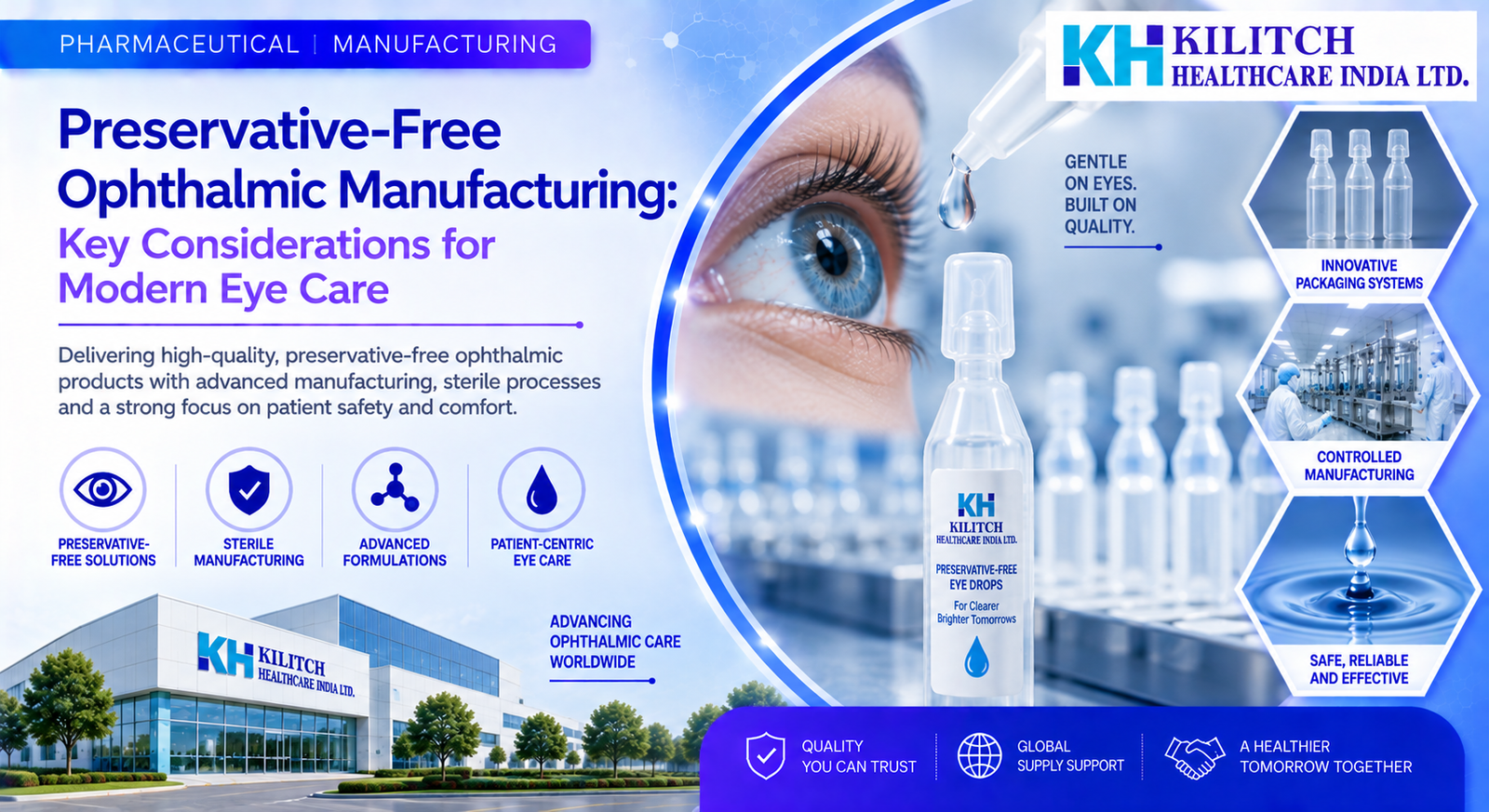
Preservative-Free Ophthalmic Manufacturing involves more than simply removing a preservative from an existing formulation. Manufacturers must consider formulation stability, microbiological safety, packaging compatibility, dosing performance, and the intended shelf life of the product.
For pharmaceutical companies evaluating a manufacturing partner, choosing an organization with relevant capabilities can support a structured development and commercialization pathway. ophthalmic manufacturing is among the specialized areas addressed by Kilitch Healthcare.
Understanding the Need for Preservative-Free Formulations
Preservatives can serve an important function in certain multidose ophthalmic products by helping control microbial growth after opening. However, their suitability depends on the formulation, dosage form, container-closure system, intended use, and applicable regulatory requirements.
Preservative-free products approach microbiological protection differently. Instead of relying on a preservative within the formulation, manufacturers may use suitable sterile manufacturing processes, specialized packaging systems, single-dose presentations, or appropriately designed multidose delivery technologies.
The objective is to maintain product quality and microbiological integrity while delivering a formulation that meets its intended performance requirements.
Key Challenges in Preservative-Free Ophthalmic Manufacturing
Developing preservative-free ophthalmic products requires careful coordination between formulation science, manufacturing, packaging, quality assurance, and regulatory considerations.
Maintaining Sterility and Microbiological Quality
Sterility is a fundamental requirement for many ophthalmic dosage forms. Manufacturing environments, equipment, personnel practices, material handling, filling operations, and container-closure systems must be appropriately controlled to reduce contamination risks.
For sterile eye drops manufacturing, process design should consider the entire product lifecycle, from preparation and filling through packaging and storage. Appropriate validation and microbiological controls are essential for demonstrating that the manufacturing process consistently produces products meeting established specifications.
Ensuring Formulation Stability
Removing a preservative may influence formulation characteristics. Developers need to assess physical and chemical stability, compatibility between ingredients, pH, osmolality, viscosity, appearance, and other relevant quality attributes.
Ophthalmic formulation development therefore requires a systematic approach. The formulation must remain suitable throughout its proposed shelf life while maintaining the desired therapeutic and physical characteristics.
Selecting the Right Packaging System
Packaging plays an especially important role in preservative-free eye care. A suitable container-closure system needs to protect the formulation while supporting safe and convenient administration.
For multidose products, the delivery system must be designed to help minimize contamination during repeated use. Depending on the product and target market, specialized dispensing technologies can provide an alternative approach to conventional preservative-containing multidose packaging.
This makes packaging development an integral part of Preservative-Free Ophthalmic Manufacturing rather than an activity performed only after formulation development.
The Role of Ophthalmic Manufacturing Technology
Advances in ophthalmic manufacturing technology are creating new possibilities for pharmaceutical companies developing preservative-free products. Modern systems can combine controlled filling processes with specialized delivery mechanisms and packaging configurations.
For example, Kilitch Healthcare highlights technologies including Novelia Pure Flow Technology and the 3K Triple Protection System on its official website. These technologies are presented as solutions designed to support preservative-free ophthalmic delivery through specialized packaging and dosing approaches.
From Formulation to Delivery
An effective ophthalmic product requires more than a suitable active pharmaceutical ingredient. The formulation, manufacturing process, container, closure, dispensing mechanism, and user experience must work together.
For pharmaceutical companies, this integrated approach can be particularly valuable when developing preservative-free eye drops or other sterile ophthalmic products. Early consideration of the final delivery system can help ensure that formulation and packaging requirements remain aligned throughout development.
Quality Considerations in Sterile Ophthalmic Manufacturing
Quality control is central to ophthalmic drug manufacturing because the finished product must meet stringent requirements for its intended route of administration.
Controlled Manufacturing Processes
Sterile ophthalmic manufacturing requires appropriate environmental and process controls. Depending on the dosage form and manufacturing strategy, important considerations may include controlled cleanroom environments, sterilization or aseptic processing approaches, validated equipment, personnel controls, environmental monitoring, and appropriate in-process testing.
Quality systems should also cover raw material controls, batch documentation, equipment qualification, process validation, analytical testing, and finished-product release.
Consistency Across Commercial Batches
For B2B pharmaceutical companies, consistency is just as important as successful product development. A formulation that performs well during laboratory or pilot development must be capable of being manufactured reproducibly at commercial scale.
Manufacturing partners should therefore have appropriate systems for technology transfer, scale-up, process optimization, and ongoing quality monitoring.
Kilitch Healthcare states that its manufacturing operations employ pharmaceutical GMP practices and that its broader manufacturing capabilities include ophthalmic formulations.
Choosing a Partner for Ophthalmic Drug Manufacturing
Selecting a manufacturing partner is a strategic decision for pharmaceutical companies planning to launch or expand an ophthalmic portfolio. The right partner should be evaluated across technical capabilities, manufacturing infrastructure, quality systems, development support, scalability, and regulatory readiness.
Evaluate Development and Manufacturing Capabilities
Companies should consider whether a prospective partner can support the complete product journey. This may include formulation development, analytical development, pilot batches, technology transfer, scale-up, commercial manufacturing, packaging, and quality documentation.
A partner with experience across these areas can help create better coordination between development and manufacturing teams.
Consider Specialized Ophthalmic Expertise
Ophthalmic products have specific formulation and packaging requirements that differ from many other pharmaceutical dosage forms. Experience with sterile manufacturing, eye-drop delivery systems, ophthalmic suspensions, gels, or other ophthalmic presentations can therefore be valuable.
Kilitch Healthcare identifies ophthalmic formulations as one of its manufacturing areas and operates an Eyekare Division focused on ophthalmic solutions and technologies.
Benefits of a Structured Preservative-Free Development Approach
A structured approach to Preservative-Free Ophthalmic Manufacturing can help pharmaceutical companies address technical and commercial requirements from the early stages of development.
Better Alignment Between Formulation and Packaging
When formulation and packaging decisions are evaluated together, developers can identify potential compatibility, stability, dosing, and contamination-control considerations earlier in the development process.
Greater Flexibility for Product Portfolios
Preservative-free technologies can support different ophthalmic product concepts depending on the active ingredient, dosage form, intended use, target market, and delivery requirements.
For companies developing private-label or contract-manufactured products, early alignment with the manufacturing partner can also simplify discussions around specifications, packaging formats, production requirements, and commercialization plans.
Supporting Long-Term Product Quality
The ultimate objective is consistent product quality throughout the commercial lifecycle. This requires continuous attention to manufacturing controls, raw materials, equipment, analytical methods, packaging performance, and process consistency.
Future Outlook for Preservative-Free Eye Care
The development of preservative-free eye care continues to encourage innovation across formulations, packaging, delivery systems, and manufacturing processes. As pharmaceutical companies seek differentiated ophthalmic products, specialized manufacturing technologies can become an important part of product development strategies.
For manufacturers, the focus is increasingly moving toward integrated solutions in which formulation science, sterile processing, packaging technology, quality control, and scalability are considered together.
For pharmaceutical companies, this means that selecting an experienced partner early in the development process can help establish a clearer path from concept to commercial production.
Conclusion
Preservative-Free Ophthalmic Manufacturing requires a coordinated approach to formulation development, sterile processing, packaging, microbiological protection, quality control, and commercial scalability. The right combination of pharmaceutical expertise and ophthalmic manufacturing technology can help companies develop products that meet defined quality and performance requirements.
As demand for specialized ophthalmic products continues to evolve, pharmaceutical businesses can benefit from working with manufacturing partners that understand the technical requirements of ophthalmic drug manufacturing and can support development through commercial production. Kilitch Healthcare offers pharmaceutical manufacturing capabilities that include ophthalmic formulations for businesses exploring specialized manufacturing solutions.