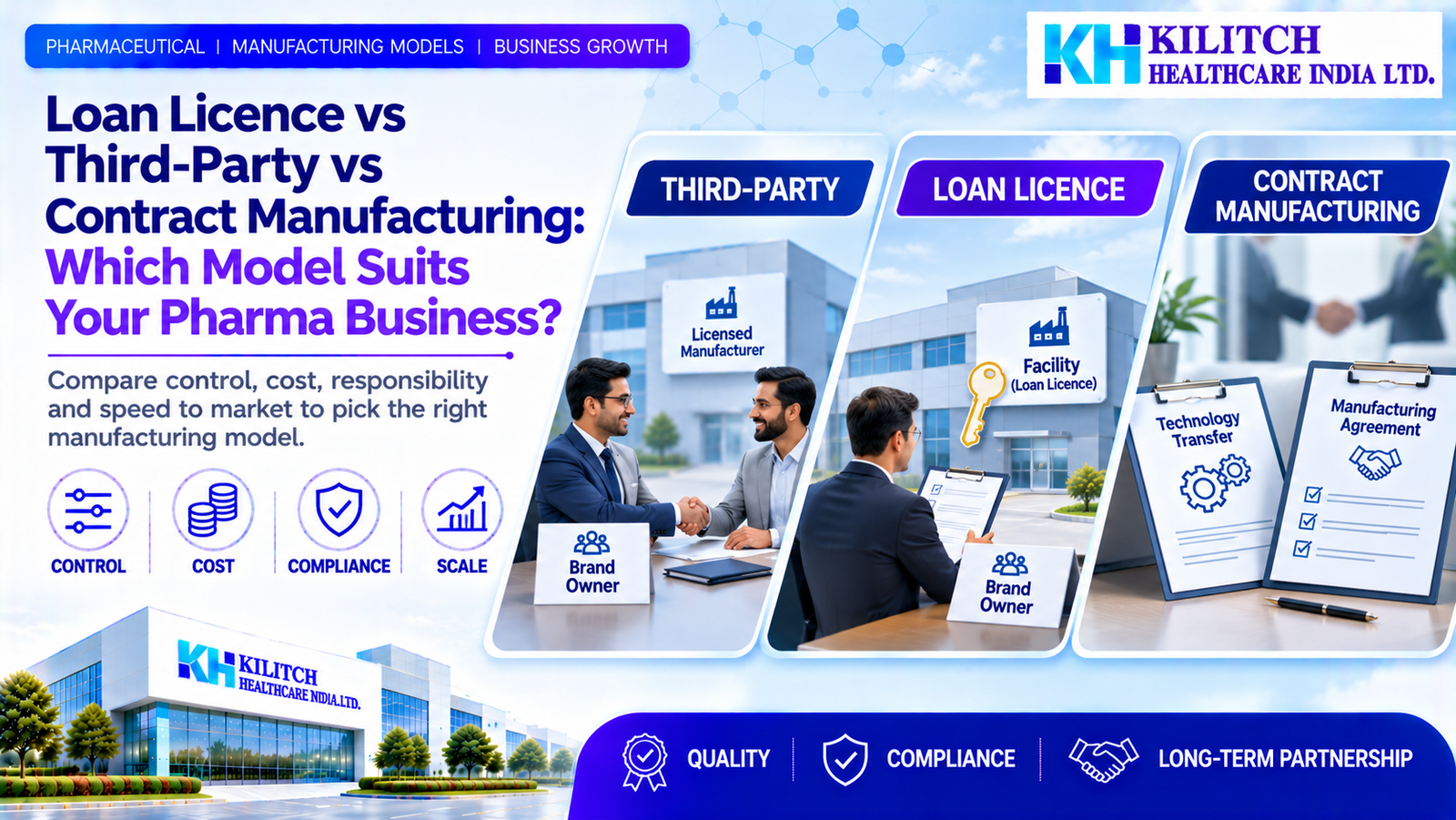
India’s pharmaceutical industry offers several ways for companies to get products made without owning a factory. The three models discussed most often are loan licence manufacturing, third-party manufacturing and contract manufacturing. The terms are sometimes used interchangeably, but they involve different levels of control, investment and regulatory responsibility.
Choosing the right model is a strategic decision. It affects your costs, your control over quality, your speed to market and your long-term growth. This guide explains each model clearly and helps you decide which one suits your business.
Third-Party Manufacturing
How It Works
In third-party manufacturing, a licensed manufacturer produces medicines under its own manufacturing licence, and the products are marketed under the brand name of another company. The manufacturer’s name appears on the label as the manufacturer, and the marketing company’s name appears as the marketer.
Who It Suits
- Pharma marketing companies and distributors
- Start-ups entering the pharma market
- Businesses wanting to add products quickly without technical investment
Advantages
- Low investment and minimal technical requirements
- Fast product launches using existing formulations
- Manufacturer handles production, quality and regulatory compliance at the site
Limitations
- Less control over the manufacturing process
- Formulations may not be exclusive
- Dependence on the manufacturer’s capacity and schedules
Loan Licence Manufacturing
How It Works
In loan licence manufacturing, the brand owner obtains its own licence to manufacture specific products, but uses another company’s manufacturing facility and equipment. The brand owner effectively “borrows” the facility while holding the licence itself.
Who It Suits
- Established companies wanting more control over their products
- Businesses planning to own manufacturing in the future
- Companies with technical teams able to oversee production
Advantages
- Greater control over formulation, process and quality
- Products are linked to the brand owner’s own licence
- A step towards building independent manufacturing capability
Limitations
- More regulatory responsibility for the brand owner
- Requires technical staff and quality oversight
- Licensing process takes longer than simple third-party arrangements
Contract Manufacturing (CMO / CDMO)
How It Works
Contract manufacturing is a broader, often long-term partnership where a contract manufacturing organisation produces products to the client’s specifications. When development services are included, the partner is called a CDMO, or contract development and manufacturing organisation. Contract manufacturing is common for both domestic and export markets and frequently involves technology transfer of the client’s own processes.
Who It Suits
- Domestic and international pharma companies
- Companies with their own formulations or dossiers
- Businesses supplying regulated or semi-regulated export markets
Advantages
- Access to specialised capabilities, such as sterile injectables or ophthalmics
- Scalable capacity for large volumes
- Support with development, technology transfer and regulatory documentation
- Long-term supply relationships
Limitations
- Requires detailed quality and supply agreements
- Technology transfer takes time and planning
- Larger minimum order quantities may apply
Read more in how contract drug manufacturing works and our overview of pharmaceutical technology transfer.
Side-by-Side Comparison
| Factor | Third-party | Loan licence | Contract manufacturing |
| Licence holder | Manufacturer | Brand owner | Usually manufacturer, per agreement |
| Brand owner control | Low | High | Medium to high |
| Investment needed | Low | Medium | Medium |
| Technical team needed | Minimal | Yes | Helpful, depends on scope |
| Speed to market | Fast | Moderate | Moderate |
| Typical client | Marketing companies | Established brands | Domestic and global pharma |
| Exclusivity of formulation | Often limited | High | High |
Key Questions to Help You Decide
- How much control do you need? If you need tight control over formulation and process, loan licence or contract manufacturing may suit you better.
- Do you have a technical team? Loan licence arrangements need people who can oversee manufacturing and quality.
- How fast do you need to launch? Third-party manufacturing is usually quickest.
- Are you targeting export markets? Contract manufacturing with an experienced, WHO-GMP certified partner often suits international supply.
- What is your long-term plan? If you aim to build your own factory later, a loan licence can be a stepping stone.
Quality and Compliance in Every Model
Whatever model you choose, quality responsibilities must be clearly defined. A written quality agreement should set out who is responsible for raw material testing, batch release, deviations, complaints, recalls and regulatory submissions. With revised Schedule M now applying to manufacturing units across India, it is also important to confirm your partner’s GMP compliance status. See why choosing a WHO-GMP pharmaceutical manufacturer is essential.
Common Mistakes to Avoid
- Choosing a model based only on cost
- Signing agreements without a clear quality agreement
- Overlooking capacity planning for future growth
- Not visiting or auditing the manufacturing site
- Failing to plan for regulatory requirements in target markets
Intellectual Property and Confidentiality
When you share formulations, processes or dossiers with a manufacturing partner, protecting your intellectual property is essential. Confidentiality agreements should be signed before detailed discussions begin. Contracts should clearly state who owns formulations, technical data and regulatory documents, and what happens to them if the relationship ends. In loan licence and contract manufacturing models, where brand owners often bring their own technology, these protections are especially important.
Building a Long-Term Partnership
The most successful outsourcing relationships are built on trust, transparency and shared goals. Regular review meetings, clear performance indicators such as on-time delivery and right-first-time batches, and open communication about challenges all help. Joint planning for new products and capacity ensures that the manufacturer can support your growth rather than holding it back.
Hybrid Approaches
Many companies use more than one model at the same time. A brand owner might use third-party manufacturing for established generic products, a contract manufacturer for specialised sterile products and a loan licence arrangement for key brands where control is critical. Combining models in this way allows businesses to balance cost, speed and control across their portfolio.
Getting Started
If you are unsure which model suits you, start with a conversation. Share your product list, target markets, expected volumes and long-term goals with potential partners. An experienced manufacturer can recommend the most suitable model and explain the steps, documents and timelines involved.
Frequently Asked Questions
Who is responsible for quality in third-party manufacturing?
The manufacturer is responsible for GMP at its site, while the marketer is responsible for its brand in the market. A written quality agreement should set out the details.
What is the difference between third-party and contract manufacturing?
Third-party manufacturing usually means a marketer sells products made under the manufacturer’s licence, while contract manufacturing is a broader partnership producing to the client’s specifications, often including technology transfer.
What is a loan licence in pharma?
It is an arrangement where the brand owner holds the manufacturing licence but uses another company’s facility.
Which model is best for a pharma start-up?
Third-party manufacturing is often the simplest starting point because it needs low investment and little technical infrastructure.
Can I switch models later?
Yes. Many companies start with third-party manufacturing and move to contract or loan licence arrangements as they grow.
Find the Right Manufacturing Partner
Kilitch Healthcare supports partners through pharmaceutical contract manufacturing services across sterile ophthalmic and injectable products. Contact us to discuss the model that suits your business.