Introduction: Why Technology Transfer Matters
Drug product technology transfer is the structured process of moving product and manufacturing knowledge from a development environment, originating site or established process into a receiving manufacturing operation. The objective is to reproduce the product and process consistently while maintaining defined quality requirements. Kilitch Healthcare works across pharmaceutical development and specialized manufacturing, making technology transfer an important bridge between product development and commercial production.
What Is Drug Product Technology Transfer?
A drug product technology transfer brings together the technical information required for another team or manufacturing site to understand, reproduce and control an established pharmaceutical product. This can include formulation information, manufacturing procedures, process parameters, specifications, analytical methods, packaging requirements and relevant development knowledge.
Technology transfer is not simply the exchange of documents. The receiving team needs to understand how the product behaves, which process variables are important and which controls are critical to maintaining quality. Effective transfer therefore combines documentation, technical communication, practical evaluation and appropriate verification.
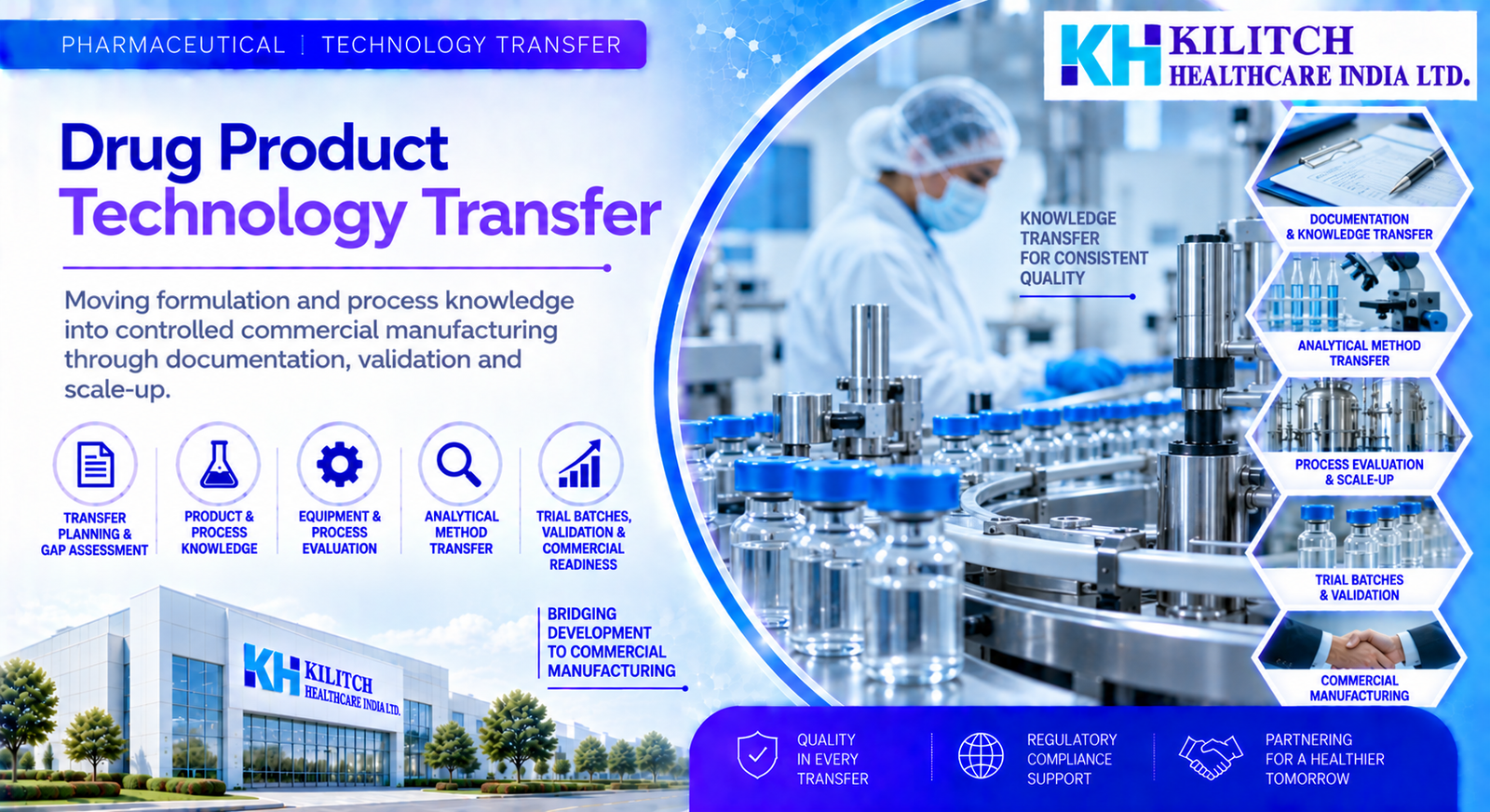
Key Stages of Drug Product Technology Transfer
1. Transfer Planning and Gap Assessment
A successful transfer begins with a defined plan covering the sending and receiving teams, product scope, responsibilities, timelines and required information. A gap assessment can identify differences in equipment, facilities, materials, analytical capabilities and manufacturing procedures before transfer activities begin.
This early assessment is valuable because a process developed using one set of equipment may not behave identically on another manufacturing platform. Identifying differences in advance allows the teams to determine which parameters require additional evaluation or adaptation.
2. Compilation of Product and Process Knowledge
The transfer package should contain the information needed to understand the product and its manufacturing process. Depending on the dosage form, this may include formulation composition, material specifications, manufacturing instructions, critical process parameters, in-process controls, finished-product specifications, packaging information and stability data.
Development reports and process knowledge can also provide useful context. They explain why particular conditions were selected and help the receiving team understand which variables may have the greatest impact on product quality.
3. Equipment and Process Evaluation
The receiving site evaluates whether its equipment and manufacturing environment can support the transferred process. Differences in vessel capacity, mixing characteristics, filling equipment, temperature control or other operating features may affect process performance. The objective is to establish whether the existing process can be reproduced or whether controlled adjustments are required.
4. Analytical Method and Quality Transfer
Analytical methods are an important part of technology transfer because they provide the measurements used to evaluate product quality. The receiving laboratory needs suitable procedures, specifications, reference materials and trained personnel. Method transfer or verification activities may be required according to the product and applicable quality requirements.
5. Trial Batches, Validation, and Commercial Readiness
Where appropriate, engineering or demonstration batches can help evaluate the transferred process under receiving-site conditions. These activities generate practical information about equipment performance, material behavior and process controls. Further qualification or validation activities are then performed according to the established transfer and quality strategy.
Technology Transfer and Pharmaceutical Scale-Up
Technology transfer is closely connected with scale-up when a product moves from development or pilot manufacturing into larger commercial batches. Increasing batch size can change mixing, heat transfer, filling behavior and material movement. A process that performs well at development scale therefore needs to be assessed against the characteristics of commercial equipment.
Scale-up should preserve the product’s established quality attributes while creating a process that can be operated consistently. Transfer teams use development knowledge and process data to understand which variables are most important and how they should be controlled at the receiving scale.
Documentation and Knowledge Management
Clear documentation provides the foundation for an effective technology transfer. Transfer protocols, reports, specifications, manufacturing instructions, analytical procedures and change records help establish traceability throughout the project. Documentation should also capture decisions made during the transfer so that the final commercial process reflects the knowledge gained during development and implementation.
Technical communication is equally important. Meetings between formulation, process development, quality, analytical and manufacturing teams can help resolve questions that may not be obvious from written documents alone. This collaboration supports a common understanding of the product and its critical requirements.
Common Challenges in Drug Product Technology Transfer
Differences in Equipment and Facilities
Equipment at the receiving site may differ in capacity, design or operating characteristics from the development setup. These differences can influence process behavior and may require additional assessment. A structured comparison of equipment and process requirements helps identify potential risks before manufacturing begins.
Incomplete Process Knowledge
A transfer can become more difficult when development information does not clearly explain process rationale or critical variables. Capturing development knowledge, including important process observations and historical decisions, can give the receiving team a stronger foundation for implementation.
Communication Across Teams
Technology transfer often involves multiple functions and organizations. Clear responsibilities, agreed documentation and regular technical communication can reduce misunderstandings and help keep transfer activities aligned with quality and commercial objectives.
Why an Integrated Development and Manufacturing Partner Matters
An integrated partner can connect formulation development, process development, manufacturing, analytical testing and quality activities throughout the transfer. This continuity can help reduce information gaps and make it easier to evaluate how development decisions translate into commercial production. pharmaceutical development and manufacturing capabilities are therefore relevant when companies are assessing a partner for a product that needs to move from development into routine supply.
An integrated approach can also support faster identification of practical manufacturing constraints. When development and production teams work closely together, equipment suitability, process controls, packaging and testing requirements can be considered before commercial batches are scheduled.
How to Evaluate a Technology Transfer Partner
Companies evaluating a technology transfer partner should consider its experience with the relevant dosage form, development infrastructure, manufacturing capabilities, quality systems and analytical support. The partner should be able to understand technical documentation while also translating that information into controlled manufacturing activities.
It is also useful to assess whether the manufacturer can support the full pathway from transfer through commercial supply. Businesses evaluating Kilitch Healthcare can review its broader pharmaceutical capabilities to determine how well its development, manufacturing and quality environment aligns with the product’s requirements.
Drug Product Technology Transfer at Kilitch Healthcare
Kilitch Healthcare operates across pharmaceutical development and manufacturing, with capabilities covering specialized products such as sterile injectables, ophthalmic formulations, nasal formulations and prefilled delivery systems. This breadth is relevant to technology transfer because different dosage forms can require different process controls, equipment considerations and analytical requirements.
For companies transferring an established drug product, the objective is to create a controlled path from existing product knowledge to repeatable manufacturing. The specific transfer strategy depends on the product, process history, equipment, quality requirements and intended scale, but structured planning and technical collaboration remain central to the process.
Conclusion: Turning Product Knowledge Into Commercial Manufacturing
Drug product technology transfer connects pharmaceutical development knowledge with controlled manufacturing. A well-planned transfer addresses product and process information, equipment suitability, analytical methods, scale-up, documentation, validation and quality controls so that the receiving operation can reproduce the product consistently. Kilitch Healthcare provides pharmaceutical development and manufacturing capabilities that can support businesses evaluating the transition from established product knowledge to commercial pharmaceutical production.