


Sterile Injectable Manufacturing | What Sets World-Class Facilities Apart
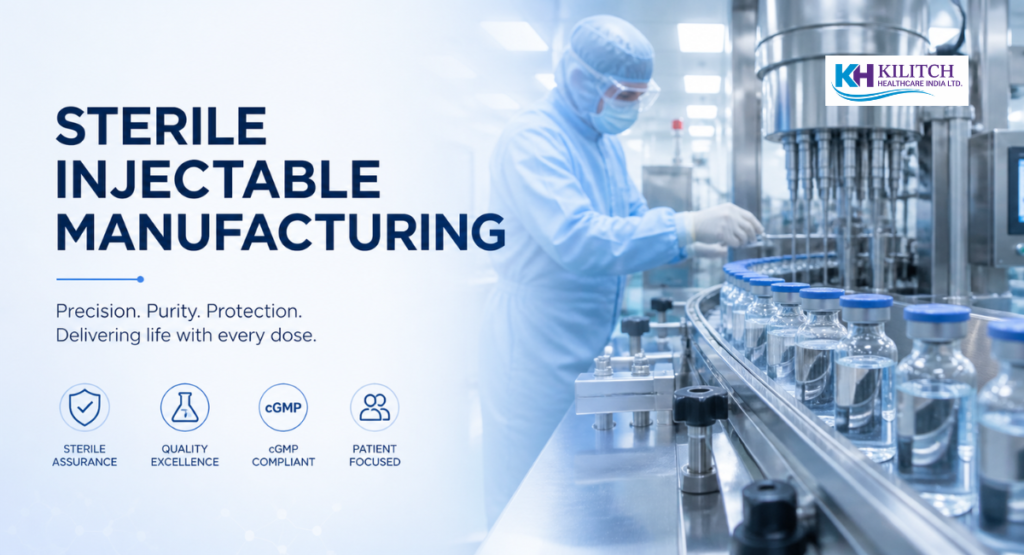
Sterile Injectable Manufacturing: Standards, Challenges, and What Sets World-Class Facilities Apart When doctors inject medication directly into a vein, muscle, or eye, the body has no natural filter. There is no digestive system to neutralize contamination. No barrier slows down a harmful particle. Therefore, everything that enters must be exactly right — in composition, concentration, and sterility. That is why sterile injectable manufacturing ranks among the most demanding disciplines in pharma. It combines precision engineering, rigorous science, and strict regulatory compliance. Together, these elements produce drug products that patients and clinicians trust completely. At Kilitch Healthcare, this is not just a service. It is a core commitment, backed by an internationally accredited facility and a culture of continuous innovation. What Is Sterile Injectable Manufacturing? Sterile injectable manufacturing involves producing drug products that enter the body through injection or infusion. These products bypass the body’s natural protective barriers. As a result, they must be completely free of microbial contamination, particulate matter, pyrogens, and foreign substances. The category includes several product types. Each one carries its own manufacturing complexity. Liquid Injectables are ready-to-use solutions filled into vials, ampoules, or prefilled syringes. Manufacturers must achieve precise formulation, pH control, and careful sterilization. These steps maintain chemical stability and biological safety. Lyophilized (Powder) Injectables use freeze-drying to remove moisture from a liquid drug product. This process extends shelf life and improves stability for sensitive molecules such as proteins, peptides, and biologics. Furthermore, manufacturers must develop and validate each lyophilization cycle for the specific formulation. Prefilled Syringes (PFS) deliver pre-measured doses in ready-to-use syringe barrels. They reduce dosing errors and limit contamination at the point of care. However, they also demand high-precision filling equipment and rigorous container compatibility testing. Additionally, sterile injectables serve critical therapeutic areas. These include oncology, ophthalmology, critical care, and immunology. In all these fields, manufacturing quality directly affects patient safety. The Regulatory Framework: Standards That Cannot Be Compromised Sterile injectable manufacturing operates under some of the strictest regulatory oversight in the world. To serve global markets, a manufacturer must comply with multiple international standards. There is no shortcut. WHO-GMP forms the global foundation. It covers facility design, personnel hygiene, process validation, and quality control systems. Moreover, WHO-GMP compliance is a prerequisite for supplying regulated markets across Asia, Africa, and beyond. US FDA 21 CFR Part 211 governs access to the American market — one of the most scrutinized regulatory environments globally. Manufacturers must maintain rigorous documentation, validated processes, and robust change control systems. EU GMP Annex 1 has recently undergone significant revision. It places heightened focus on Contamination Control Strategy (CCS) and barrier technologies such as isolators and RABS. In addition, it mandates comprehensive environmental monitoring throughout production. Schedule M (Revised) sets pharmaceutical manufacturing standards within India. It increasingly aligns domestic requirements with global benchmarks. ISO 14644 defines cleanroom classification — from Grade A through Grade D. Each grade corresponds to a specific stage of sterile manufacturing. Consequently, manufacturers must maintain constant monitoring, validated HVAC systems, and strict personnel discipline. Kilitch Healthcare’s facility spans 3,50,000 square feet in Mumbai. The team designed and built it to comply with all major international regulatory standards. As a result, it enables supply to both domestic and global regulated markets from a single, accredited location. The Sterile Injectable Manufacturing Process: From Raw Material to Release Understanding each step inside a GMP-compliant facility shows why quality cannot be compromised at any stage. Step 1 – Raw Material Testing and Release First, every ingredient enters a rigorous testing protocol. The Quality Assurance team checks the active pharmaceutical ingredient (API), excipients, and container components. They verify identity, purity, and quality before approving any raw material for production. Step 2 – Formulation Development Next, scientists develop and optimize the drug formulation. They evaluate stability, solubility, pH, osmolality, and container compatibility. For complex molecules, this phase also includes stress testing and accelerated stability studies. Step 3 – Cleanroom Preparation and Environmental Monitoring Before filling begins, the team certifies cleanrooms and disinfects all surfaces. They then initiate environmental monitoring. This measures airborne particle counts, microbial levels, and temperature. Only after the environment meets specification does production start. Step 4 – Filling Operations The team fills liquid injectables under aseptic conditions in Grade A zones (ISO Class 5). Grade B background environments surround these zones at all times. For powder injectables, operators choose between aseptic filling and terminal sterilization. Meanwhile, automated, high-precision lines fill prefilled syringes with minimal human contact. Step 5 – Sterilization The formulation determines the choice of sterilization method. Terminal sterilization (autoclaving) works well when the drug and container can tolerate the heat. However, for heat-sensitive molecules, manufacturers use aseptic processing instead. They sterilize all components separately and then combine them in a sterile environment. In either case, each method must achieve a Sterility Assurance Level (SAL) of 10⁻⁶ or better. Step 6 – Inspection and Leak Testing After filling, every unit goes through 100% visual inspection. Inspectors check for particulate matter, clarity, fill volume, and container integrity. Automated inspection systems work alongside trained human inspectors. Together, they provide multiple layers of assurance. Additionally, Container Closure Integrity Testing (CCIT) confirms hermetic seals throughout the product’s shelf life. Step 7 – Labeling, Packaging, and Batch Release Finally, the team labels and packages finished products. They then conduct Quality Control (QC) testing for sterility, endotoxin, potency, and container closure. A Qualified Person reviews all results before authorizing the batch for release. Core Challenges in Sterile Injectable Manufacturing Even experienced manufacturers face ongoing technical and operational challenges. These require continuous investment and vigilance. Maintaining Aseptic Conditions is the most fundamental challenge. A single breach in gowning protocol can compromise an entire batch. Similarly, a momentary lapse in airflow or an unvalidated equipment surface poses the same risk. The stakes are always high. Particulate Contamination Control requires constant environmental monitoring. Any out-of-trend result triggers a thorough investigation. Sources of contamination — including personnel, equipment wear, and packaging materials — each demand rigorous control. Lyophilization Cycle Development is scientifically complex. Developers must carefully
